Showing posts with label 2000s. Show all posts

September 16, 2020

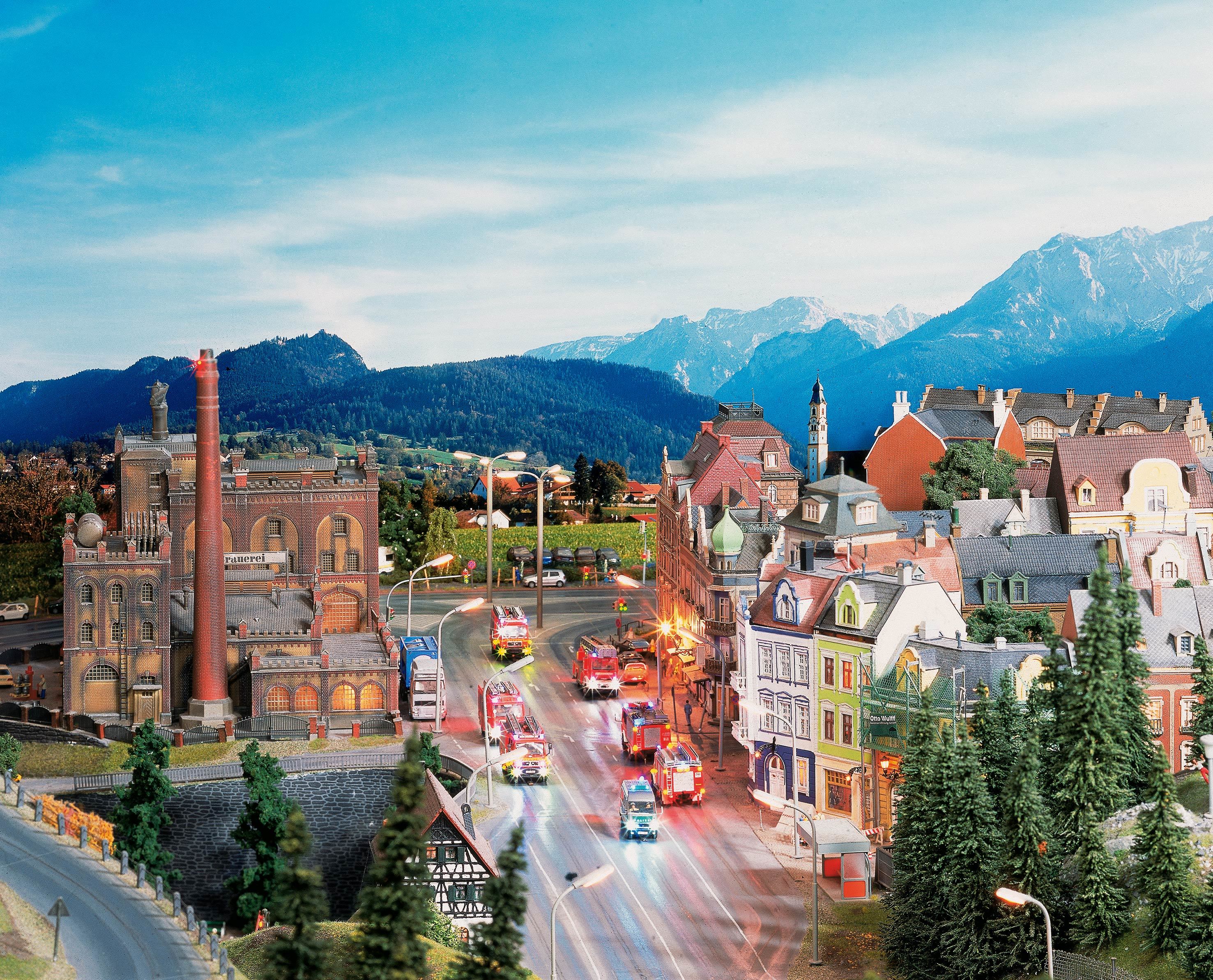
The World's Largest Model Railway System is "Miniatur Wunderland" in Hamburg, Germany.

Frederik and Gerrit Braun, brothers, set out to build the largest model railway system in the world. They established the "Miniatur Wunderland" in 2000. 
Take a look at what 20 years of non-stop design and construction work accomplished in the videos below.
Official Miniatur Wunderland Video. [04:54]

Miniatur Wunderland World’s Largest Model Railway. [04:07]

Miniatur Wunderland Hamburg, May 2020. [1:30:20]
This video takes you to all the theme worlds.

THEME WORLDS:

  • Santa Fu - The Austrian prison is home to the Wunderland’s most evil villains.
  • Schauertal Bridge
  • St. Wendelberg - A Train Track Complex Matrix 
  • Ski Lifts
  • Arminius Monument - The monument was constructed between 1838 and 1875 to commemorate the Cherusci War Chief Arminius (Hermann, in German) and his victory over Rome at the Battle of the Teutoburg Forest in 9 AD.
  • Bungee Jumper
  • I.C.E. High-Speed Train - The maximum speed reaches 175mph.
  • Open Air Theater - Complex wheelwork, made of leverages, winches, and small engines, creates the most harmonious movement of tiny men and women on stage.
  • UFO - Reports of an Unidentified Flying Object in Central Germany. The UFO, obviously navigated by aliens beings, is said to hover over a field of sunflowers every now and then. 
  • Davidwache - Police Station.
  • Elbphilharmonie - Concert Hall.
  • Köhlbrand Bridge
  • St. Michael's Church
  • Speicherstadt; largest warehouse district in the world.
  • Transrapid Maglev Train
  • Volksparkstadion - Football {Soccer} Stadium
  • Colosseum
  • Mount Vesuvius
  • Pompeii
  • St. Peter's Basilica
  • Castle on Fire
  • Fire Department
  • Red Light District
  • Speed Trap
  • Terminals - 45 different aircraft, from A380 to Cessna
  • Catapult
  • Neuschwanstein Castle
  • Ship Hoist
  • Arrival Schedules - Knuffingen Airport
  • Departure Schedules - Knuffingen Airport
  • The last inaugurated section of Venice
  • Egeskov Castle
  • Real Water Basin
  • Ship Control System
  • Snow Landscape
  • The Storebælt Bridge

  • Biogas Plant
  • Cement Plant
  • Chocolate Factory
  • DJ Bobo Open Air 
  • Montebello
  • The Hammetschwand Lift
  • The Matterhorn
  • Area 51
  • Christmas Village
  • Grand Canyon
  • La Vegas
  • Mount Rushmore
  • USA-Hamburg Tunnel
  • Carnival
  • Doge's Palace
  • Procuratie
  • St. Mark's Basilica
Don't miss this unique look at the Miniatur Wunderland.

Compiled by Neil Gale, Ph.D.

September 4, 2020

The History of U.S. Paper Currency from the 1700s to Present Day.

Early American colonists used English, Spanish, and French money under English rule. However, in 1775, when the Revolutionary War became inevitable, the Continental Congress authorized the issuance of currency to finance the conflict.
1775 Continental Currency
Paul Revere made the first plates for this "Continental Currency." Those notes were redeemable in Spanish Milled Dollars, and the depreciation of this currency gave rise to the phrase "not worth a Continental."
Series 1886 Martha Washington One Dollar Certificate - Martha Washington is the first and only woman to grace the primary portrait of U.S. paper currency.
After the U.S. Constitution was ratified, Congress passed the "Mint Act" of April 2, 1792, which established the coinage system of the United States and the dollar as the principal currency unit. By this Act, the U.S. became the first country in the world to adopt the decimal system for currency. The first U.S. coins were struck in 1793 at the Philadelphia Mint and presented to Martha Washington.

The Government did not issue paper money until 1861. In the interim years, however, the Government did issue "Treasury notes" intermittently during periods of financial stress, such as the War of 1812, the Mexican War of 1846, and the Panic of 1857.

During this same period (1793 - 1861), approximately 1,600 private banks were permitted to print and circulate their own paper currency under state charters. Eventually, 7,000 varieties of these "state banknotes" were put in circulation, each carrying a different design!
With the onset of the Civil War, the Government - desperate for money to finance the war - passed the Act of July 17, 1861, permitting the Treasury Department to print and circulate paper money. The first paper money issued by the Government was "demand notes," commonly referred to as "GREENBACKS." In 1862, Congress retired the demand notes and began issuing United States notes, also called legal tender notes.
Series 1889 One Dollar Silver Certificate
Under the Congressional Acts of 1878 and 1886, five different issues of "silver certificates" were produced, ranging from $1 to $1,000 notes. The Treasury exchanged silver certificates for silver dollars because the size and weight of the silver coins made them unpopular. The last series of silver certificates were issued in 1923. However, the previous series of modern silver certificates produced was the 1957B/1935H $1 notes, series 1953C $5 notes, the 1953B $10 notes.

From 1863 to 1929, the Government again permitted thousands of banks to issue their own notes under the National Banks Acts of 1863 and 1864. These were called "national banknotes," but unlike the earlier "state banknotes," they were produced on paper authorized by the U.S. government and carried the same basic design.

In 1913, Congress passed the Federal Reserve Act, establishing this nation's Federal Reserve System. This Act authorized the Federal Reserve Banks to issue Federal Reserve Banknotes. In 1914, the Federal Reserve Banks began issuing Federal Reserve notes - the only currency still manufactured today is by the Bureau of Engraving and Printing.

Compiled by Dr. Neil Gale, Ph.D.