Showing posts with label 1800s. Show all posts

December 19, 2020

Glass Blocks; a Chicago Invention for the 1893 World's Columbian Exposition.

Glass block, or glass brick, has an interesting history and connection to Chicago via two Chicago World’s Fairs and multiple Chicago based companies.

Gustave Falconnier
Glass Designer
The 1893 World's Columbian Exposition is known for introducing many things to the United States. One lesser-known first at the World's Fair showed the United States the first glass bricks made by Gustave Falconnier. 

Falconnier, an architect, Chicago city council member, prefect of Nyon, France, and a graduate of the Ecole des Beaux-Arts in Paris held many patents in the 1880s for various types of glass blocks of interesting geometric shapes.

At the Columbian Exposition, Falconnier exhibited his glass in buildings outside of the Horticultural Building, showing their potential uses in architecture and horticulture. Falconnier was given an award by the fair commission for, “a new departure in glass building.”

Despite being shown in the horticultural pavilion, the fair commission gave him a somewhat backhanded compliment, saying that, “Their adaptability for conservatories intended for plant cultivation has not yet been fully demonstrated, but for conservatory vestibules and other rural effects they are well adapted.” And finally, “In the construction of surgical, photographic, and other experimental laboratories, where extra subdued light is required, they possess great merit.”
The Northern Pavillion of the Horticultural Building and Exhibit of Hot-Houses and Summer-Houses.
Falconnier’s glass block had a flaw that prevented it from taking hold in America. Because they were blown glass, the blocks needed a hole. Even a small hole, eventually plugged up leading to fogging. Once fogged, the bricks would need to be replaced. A tall order indeed for something that is meant to be permanently put into a wall.

Glass block would get a second chance at Chicago's Century of Progress International Exposition in 1933 before it really took hold in US architecture. However, other types of architectural glass that would be formative to glass block’s future were taking shape in Chicago.

The popularization of Art Deco glass block walls came via the crowd-pleasing thirteen houses of the future displayed at the 1933–34 Chicago World’s Fair. Glass block walls gave builders an avant-garde 20th-Century sensibility that people really liked.

The Chicago World’s Fair buildings, at the time, considered the height of American modernity, influenced United States architectural design for many years thereafter. The Century of Progress which had been planned before the crash of 1929, opened in the middle of a worldwide economic crisis. Despite that fact, or perhaps because of it, the Century of Progress resolutely focused on an optimistic vision of the United States yet to come, a premise that proved to be a wise move as it attracted so many visitors that organizers kept the fair open for a second year.
Owens-Illinois exhibit at the Chicago Century of Progress International Exposition, 1933-34.
One of the Fair's most popular exhibits featured thirteen futuristic houses clustered together on the shores of Lake Michigan. Those houses, built from innovative construction materials and with several examples clearly paying homage to the European “International Style” or the colloquial “Streamline Moderne,” turned out to be a crowd-pleaser. 

Few fairgoers actually contemplated living in homes like George Fred Keck’s Glass House, a three-story, glass-clad, polygonal tower suspended from a central pole that clearly owed a lot to Le Corbusier’s idea of the house as a “machine for living,” but most attendees marveled at the technology displayed within and without. 
Keck’s design, which the fair billed as the “House of Tomorrow,” made the June 1933 cover of Popular Mechanics.
Keck’s house controlled its own climate via central systems and sealed windows. It included not only a garage for the car but a hanger for the family plane. Keck’s design, which the fair billed as the “House of Tomorrow,” made the June 1933 cover of Popular Mechanics. The idea of an “automatic” house that heated and cooled itself, rotated to face the sun, and opened its own Venetian blinds caught the fancy of fairgoers. It likewise influenced architects throughout the United States in the subsequent years before World War II. Bits and pieces of the fair’s dramatic architecture showed up on the cultural periphery. 

Compiled by Dr. Neil Gale, Ph.D.

September 7, 2020

Why Unescorted Women Were Banned from Restaurants and Saloons — A Shocking Slice of American History.


The front window is empty now — a pale rectangle where words once ruled who could enter and who could not.


The absence speaks louder than the message ever did. It's a silence that asks readers to look closer, to remember how ordinary places once carried extraordinary exclusions. This image doesn't accuse; it invites. It lets the viewer feel the chill of history before the warmth of understanding.
A "proper" dining room of the era — spotless linens, polished service, and not a single woman allowed unless escorted by any man.


Imagine walking into a restaurant today and being told: "Sorry, ma’am — no man, no meal." Absurd. Infuriating. And Unthinkable.

Yet for most of the 19th century, that was the rule across the United States.

The Outrageous Logic of the Era
When restaurants first appeared in America in the 1820s and 1830s, they weren't the democratic, everyone‑welcome spaces we know today. They were designed as male sanctuaries — polished, candlelit temples of oysters, beefsteak, cigars, and business deals.

And women?
If a woman dared show up alone, the assumption was immediate and brutal:
She must be a prostitute.

Not "maybe."
Not "possibly."
Automatically.

Respectable women were expected to stay home, eat at home, and exist in public only when attached to a man like a decorative accessory.
Marshall Field & Co. established its first tearoom in 1890. Two decades later, the store operated seven separate dining facilities. The South Grill Room, seen here in 1909, featured Circassian walnut paneling, crystal chandeliers, and a marble fountain. It was later renamed the Walnut Room and still operates today in Macy's State Street Store.
  
Marshall Field's — Ahead of the times. 
 
In 1890, Mrs. Hering shared her homemade Chicken Pot Pie with a hungry customer so she wouldn't leave to go home for lunch. She said she would bring some friends the next day to try the Chicken Pot Pie and shop. Marshall Field opened a small tearoom with 15 tables on the 3rd floor to keep women in the store, shopping, instead of leaving for lunch. "The South Tearoom" for ladies became Chicago's first full-service dining establishment within a department store and was a runaway hit. This was parlayed into Marshall Field's Walnut Room in 1937.

The “Solutions” Were Even More Ridiculous

Hotels, forced to deal with the occasional woman traveling alone, invented a workaround that sounds like satire today:
  • Special ladies-only dining rooms
  • Separate entrances so men wouldn’t have to see them
  • Private rooms for groups of women, as long as they stayed out of sight
Some restaurants even had private rooms where men could bring “companions” — a polite 19th‑century euphemism for sex workers — for dinner and whatever “after-dinner activities” followed. But a respectable woman wanting a bowl of soup by herself?
Absolutely not.

Women Fought Back — and Built Their Own Spaces
 
By the late 1800s, American cities were changing. Women were:
  • Shopping downtown
  • Working in offices
  • Traveling independently
And they needed places to eat that didn’t treat them like contraband. So women created their own culinary world:
  • Candy shops
  • Ice cream saloons
  • Tea rooms
These started as sweet, dainty refuges — the only public spaces where women could sit, talk, and eat without male supervision. Restaurateurs assumed women wanted “light” foods: salads, pastries, delicate sandwiches, and absolutely no alcohol.

Why no alcohol?
 
Because banning booze kept out the men who wanted to drink — and therefore kept out trouble.

These women‑centered eateries became the first safe public spaces for women in American cities. They were proto–coffee shops, proto–cafés, proto–third places.

Even in the 1900s, the Rules Stayed Absurd
 
Even as the 20th century dawned, many fashionable restaurants still refused to seat unescorted women — especially at night. A woman dining alone after dark was still considered suspicious, improper, or immoral.

It took decades of protest, lawsuits, and cultural change before women could simply walk into a restaurant alone and be treated like a normal human being.

Why This History Still Shocks Us
  • Because it wasn't ancient history.
  • It wasn't medieval.
  • It wasn't "the distant past."
It was your great‑grandparents' world.  
A world where a woman eating a sandwich alone or with female friends was a scandal.

And that's why this story belongs in The History of Cool Stuff:
 
It's a reminder of how bizarre, restrictive, and downright unbelievable everyday life used to be — and how much courage it took for women to claim something as simple as a seat at the table.

                                                             Compiled by Neil Gale, Ph.D.

September 6, 2020

How Labor Day Became a National Holiday.

Labor Day is observed on the first Monday in September to pay tribute to the contributions and achievements of everyday working families. The first Labor Day holiday was celebrated on Tuesday, September 5, 1882, in New York City, in accordance with the plans of the Central Labor Union. The Central Labor Union held its second Labor Day holiday just a year later, on September 5, 1883.

A national economic downturn had begun in 1893 (The Panic of 1893), and the Pullman Company was suffering, along with many other businesses. George Pullman slashed the wages of his workers by 25% or more – but didn’t commensurately reduce their rents or the price of food. Discontented workers joined the American Railway Union (ARU), led by Eugene V. Debs, which supported their strike by launching a boycott of all Pullman cars on all railroads. ARU members across the nation refused to switch Pullman cars onto trains. When these switchmen were disciplined, the entire ARU struck the railroads on May 11, 1894. Within four days, 125,000 workers on twenty-nine railroads had quit work rather than handle Pullman cars. 
Workers leave the Pullman Palace Car Works, 1893.
Despite its size, the strike failed. Violence erupted from strikers and police some of whom were given orders to shoot and kill any demonstrator found destroying property. President Grover Cleveland deployed some 2,000 federal Army troops to Chicago and other areas (the mail wasn’t moving, so the strike had become a national issue). By the end of July, without broader support from other unions, the strike had fizzled and been defeated. During the strike, 13 workers were killed and 57 were wounded.

Following the death of the workers in June of 1894, President Grover Cleveland made reconciliation with the labor movement a top political priority and 23 more states had adopted the holiday. On June 28, 1894, President Grover Cleveland signed a law making the first Monday in September of each year a national holiday.

Compiled by Neil Gale, Ph.D.

August 31, 2020

The Paper Pail was an Invention by Chicagoan, Frederick Weeks Wilcox in 1890.

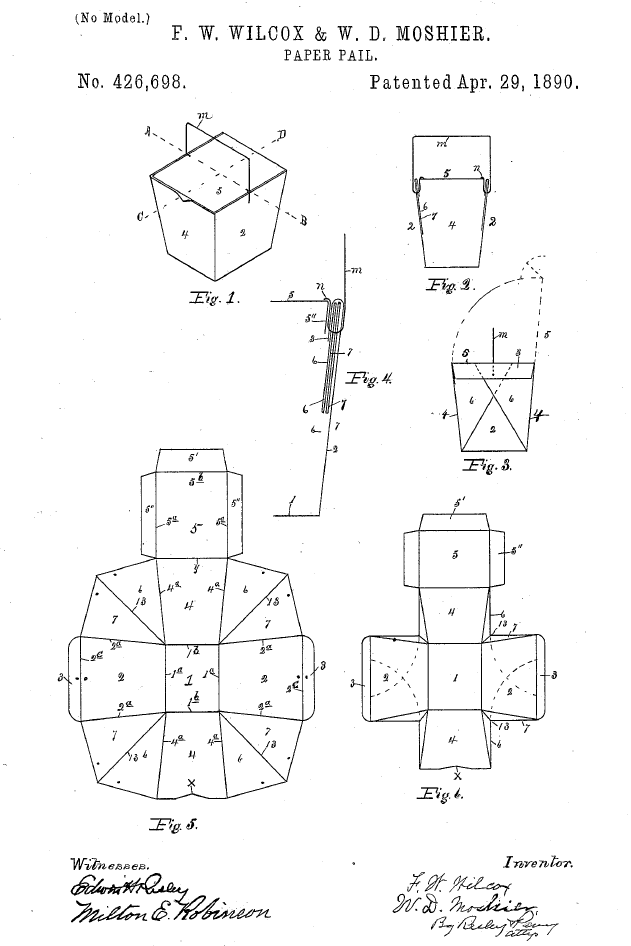
The Paper Pail or Oyster Pail was patented by Frederick W. Wilcox and William D. Moshier on April 29, l890. Patent No. 426698.


The Japanese-influenced origami folded container is uniquely a Chicago invention. Frederick Weeks Wilcox patented what he called a “Paper Pail,” in 1890. It was a single piece of paper, creased into segments, and folded into a (more or less) leakproof container secured with a dainty wire handle on top. The supportive folds on the outside, fastened with that same wire, created a flat interior surface over which food could slide smoothly onto a plate.

Use by Chinese restaurants "Chinese Takeout Box," and Oyster Houses [1] new style "Oyster Pails" for food orders or left-overs to be taken out of the restaurant.  

How to Eat Chinese Takeout.

Wilcox’s paper box seems to have been an advance in existing “oyster pail” technology. The oyster pail, as described by Ernest Ingersoll in his 1880 book: “The Oyster Industry used a wooden receptacle with a locked cover which was used in transporting raw oysters.” 

At any rate, the paper oyster pail and the incipient Chinese-food industry — which was beginning its meteoric rise in the early 20th century — seemed made for each other. “It’s nearly leakproof, and it’s disposable, and they’re really inexpensive,” says Michael Prince, who redesigned the Box O’ Joe Coffee carton for Dunkin’ Donuts. “Origami can make a really cool transport device.”

In the 1970s, a graphic designer (whose name, sadly, has been lost to history) working at the company now known as Fold-Pak, put a pagoda on the side of the box and a stylized “Thank you” on top. Both were printed in red, a color symbolic of good fortune in China, where oyster pails are little known.
And thus was forged the great paradox: “The structure has come to represent the idea of Eastern cuisine in Western society even though this packaging is not used for food containment in Chinese culture,” says Scott Chapps, designer of packaging for Help Remedies. Or, as David Federico, marketing manager for Fold-Pak, put it, “We don’t sell them in China.”

Today Fold-Pak makes oyster pails in much the same way Wilcox suggested, albeit using solid-bleached-sulfate paperboard with a poly-coating on the inside for more grease- and leak-resistance. The company has also made adjustments for modern-day behaviors: it offers microwave-safe Chinese-food cartons that use glue instead of wire and non-dyed, environmentally friendly containers. It’s a growing market, Federico says. But the traditional takeout container doesn’t seem bound for extinction. “In America, if you just drew an icon of a box, people would understand exactly what it is,” Prince said. “That’s a lot of power.”

Compiled by Dr. Neil Gale, Ph.D. 


[1] 
Chicago Oyster History.

New Englanders settle in Chicago, bringing with them a taste for oysters. Chicago had become a huge oyster town, with large multilevel oyster houses. These houses would have a dance hall, lunchroom, formal dining, and taprooms in one huge building. 

Delivered by sleigh from New Haven, Connecticut, the first fresh oysters in Chicago were served in 1838 at the Lake House Hotel on Kinzie Street. The Lake House Hotel establishment was our city’s first foray into (5-Star) fine dining and offered these East Coast imports to their well-heeled clientele. It was the first restaurant to use white tablecloths, napkins, menu cards, and toothpicks. 

This spurred Chicago’s earliest love affair with the oyster. By 1857, there were seven "Oyster Depots" and four "Oyster Saloons" in the city. Chicago's population in 1860 was 109,000. Peaking in the Gilded Age of the 1890s, with a population of 1,001,000 in 1890, and waning with Prohibition, oyster consumption was plentiful in old Chicago. Believe it or not, Ice cream parlors also served oysters because they had all that ice.

NOTE: I've been asked several times; "How fresh oysters could be coming from the east coast in 1835?" First of all, oysters were kept alive on Ice while being transported. If an oyster's shell opens, they die. Dead oysters carry dangerous bacteria for humans.

In the 1890s express-service refrigerated train cars shipped oysters and other perishable foods around the country. The cars did not come into general use until the turn of the 20th century.

August 29, 2020

How did people get to work on time before alarm clocks were invented?

Before the days of alarm clocks, people still needed to get to work on time.

A knocker-up, sometimes known as a knocker-upper, was a profession in Britain and Ireland that started during and lasted well into the Industrial Revolution before alarm clocks were invented and even after, as alarm clocks were neither cheap nor reliable. A knocker-up's job was to rouse sleeping people so they could get to work on time. By the 1940s and 1950s, this profession had died out.
The knocker-up used a baton or short, heavy stick to knock on the clients' doors or a long and light stick, often made of bamboo, to reach windows on the second floor. In return, the knocker-up would be paid a few pence a week. The knocker-up would not leave a client's window until they were sure that the client had been awoken.

A knocker-upper would also use a 'snuffer outer' as a tool to rouse the sleeping. This implement was used to put out gas lamps that were lit at dusk and then needed to be extinguished at dawn.
There were large numbers of people carrying out the job, especially in larger industrial towns such as Manchester. Generally, the job was done by elderly men and women but sometimes police constables supplemented their pay by performing the task during early morning patrols.

Mrs. Molly Moore (daughter of Mrs. Mary Smith, also a knocker-up and the protagonist of a children's picture book by Andrea U'Ren called Mary Smith) claims to have been the last knocker-up to have been employed as such. Both Mary Smith and Molly Moore used a long rubber tube as a peashooter, to shoot dried peas at their client's windows.
In Ferryhill, County Durham, miner's houses had slate boards set into their outside wall onto which the miners would write their shift details in chalk so that the employed knocker-up could wake them at the correct time. These boards were known as "knocky-up boards" or "wake-up slates."

Compiled by Neil Gale, Ph.D.