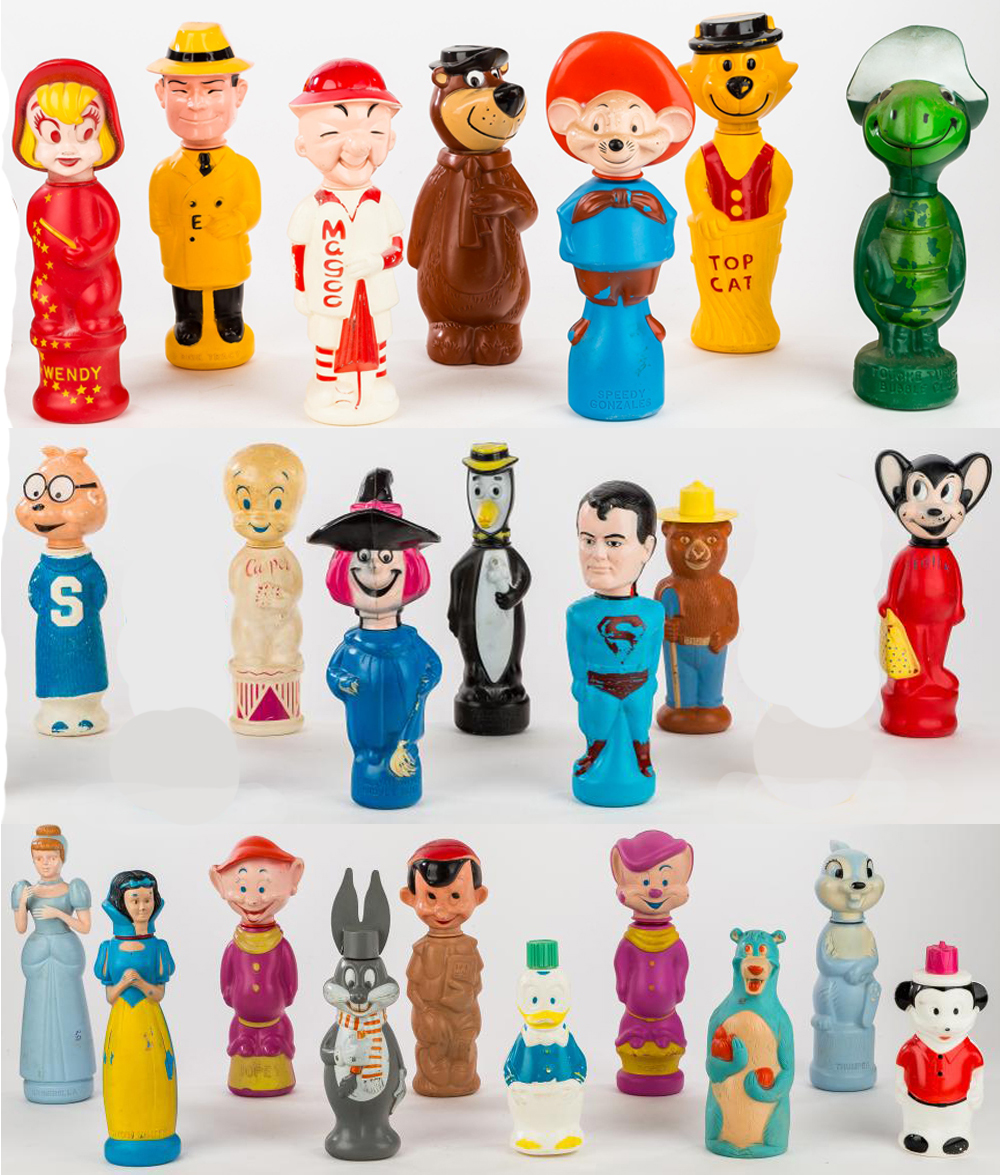
Soaky was the name of a brand of bubble bath produced by Colgate-Palmolive. The product was referred to as “The Fun Bath” on its label and was targeted at young children.
Soaky’s major selling point was that the bottles could be reused as toy figures once the contents were used up. The brand’s mascot was a young boy named The Soaky Kid.
Soaky was the name of a brand of bubble bath produced by Colgate-Palmolive. The product was referred to as “The Fun Bath” on its label and was targeted at young children.
Soaky’s major selling point was that the bottles could be reused as toy figures once the contents were used up. The brand’s mascot was a young boy named The Soaky Kid.
The product’s popularity peaked in the 1950s and 60s, during which time Colgate-Palmolive was able to secure licenses to use popular Disney and Warner Bros. cartoon characters to sell Soaky. These included, but were not limited to, Bugs Bunny, Casper the Friendly Ghost, Mickey Mouse, Pluto, Bullwinkle J. Moose, and The Chipmunks.
Colgate-Palmolive even went as far as to release a special promotional greeting card featuring the Chipmunks that doubled as a playable record. The combination of the promotional methods led the product to take a large share of the children's bath products market.
There’s an interesting story behind the creation of balsa wood model airplanes. The first official aircraft flight by Orville and Wilbur Wright occurred in 1903.
Paul K. Guillow
Balsa wood airplanes began in 1926 when former WWI US Navy aviator Paul K. Guillow (pronounced Gill-Low) started a company the "Nu Craft Toys" in 1926. Guillow’s first line of WWI military airplane models was the Thomas Morse Scout, Fokker D.VII, and Sopwith Camel made out of balsa wood. Guillow sold his kits for 10¢ apiece.
In 1927 when Charles A. Lindbergh flew from New York to Paris, the nation’s interest in aviation soared. As a result, Guillow’s model airplane kits were in such demand that Guillow had to move his toy company out of his family's suburban Boston barn to a larger place, and again to an even larger one in 1933, to the present location at 40 New Salem Street in Wakefield, Massachusetts. The name of the company was changed to Paul K. Guillow, Inc., and is still in business today.
The first product line of balsa wood airplanes was of WWI biplane fighters that sold very well right up to the mid-1940s. During WWII, balsa wood was harder to get since it was being used to produce life rafts and life jackets for the war. Model builders were forced to use paper cardboard and pine, though not always successfully. Post-war, plastic models became popular, which caused a decline in the simpler planes. But the 1950s saw a renewed interest in balsa wood airplanes—an interest that continues today.
The Guillow company added Spitfires, Messerschmitts, Zeros, Piper Cubs, and Cessnas. For years, Guillow was able to make a living by designing and producing such kits (most of which the company continues to make, despite a dwindling market for them), but it was the introduction of his ready-to-fly gliders and rubber-band-powered toy airplanes that made the business take off. Sold all over the world, they are now the company’s bread and butter.
Over the decades, Guillow’s company produced many different models. Among the most popular:
JetFire – Balsa Wood Glider
Sky Streak – sports a rubber band powered propeller
Balsa Twin Biplanes – features Sopwith Camel and Fokker D.II. (WWI fighter planes)
Balsa Flying Machine – 17″ version of the classic balsa airplane; can take off from a flat surface
Company president Alson Earl Smith, started at Guillow’s in the 1930s as a model designer, eventually taking over the day-to-day management of the company after the death of Paul Guillow in 1951. Al Smith, Alson's son, was named president in 1990.
Guillow’s now makes more than $5 million a year, Smith says and has bought out its domestic competitors, Comet of Chicago and Tiger in Los Angeles. It has expanded its product line but never strayed from its core business: flying models and toys. The Guillow family still retains ownership, and the company retains the atmosphere of a mom-and-pop operation. Nestled in low-slung buildings in an industrial section of Wakefield, the company makes its products pretty much the way it always has. The balsa is shipped from farms in Ecuador, then milled and cut into small strips. Most of the manufacturing is still done with 1940s-era machinery. It’s labor-intensive, admits Smith, who oversees about 60 employees, many of whom have worked for the company for decades.
Because it is lightweight, balsa is perfect for flying, but it is also fragile, as many a disappointed youngster has learned. Take Robert Higgins, age unknown, who wrote the company in 1959 after his Guillow airplane was destroyed by crashing to earth:
“I have bought one of your fifty-cent planes, and it broke as soon as it left the ground. If you don’t make your rotten fifty-cent plane better, my friends & I won’t buy your planes anymore. I think you have the lousiest planes from the lousiest wood (please take this as an insult), drop dead.”—Robert Higgins
To Robert Higgins, wherever he is now, Smith answers that the company tried to address the durability issue. One employee tried shellacking the wings to temper them. The wings didn’t break, but the airplane didn’t fly—too heavy. The company has also experimented with Styrofoam and expanded polystyrene, and even looked at vacuum-formed kits. But these solutions added greatly to the cost, and the aircraft ended up breaking as often as balsa did.
Despite the frustrations of Higgins and others, despite the onslaught of video games, computers, and whatever the latest toy fad happens to be, Guillow’s airplanes have found a niche.
As the company celebrated its 95th anniversary, Smith described the enduring appeal of these simple toys: “My father used the term ‘a yearning for flight.’ That feeling at an airport where you just stop by a window and pause to watch the planes take off. It’s just something inside you.”
Guillow also makes radio-controlled kits.
How To Modify and Fly a Tethered Rubber Power Model
How about you? Do you remember these classic retro toys? When’s the last time you sent a balsa airplane into the sky?
Deluxe Reading was a toy manufacturer based in Elizabeth, New Jersey USA which produced toys under several brand names including Deluxe Topper, Deluxe Toy Creations, Deluxe Reading, Topper Corp., Topper Toy Group, and Topper Toys. The Topper Toys brand was most used in print advertisements and television commercials (children's TV). It was founded and run by Henry Orenstein, a holocaust survivor.
In a long list of “you’ll poke your eye out” toys, Sixfinger has to top the list. What kid wouldn’t want a sixth finger? Especially when that sixth finger shoots cap bombs, “secret bullets,” message missiles, and fragmentation bombs. It also acts as a ballpoint pen, which helps with filling out those emergency room admission forms. Plus, it looks a little... disturbing.
Rockets, boats, cars, motorcycles, and animals were all very popular coin-operated rides from the 1950s and 60s. Forty great photographs. Which ones did you ride?