There’s an interesting story behind the creation of balsa wood model airplanes. The first official aircraft flight by Orville and Wilbur Wright occurred in 1903.
Paul K. Guillow
Balsa wood airplanes began in 1926 when former WWI US Navy aviator Paul K. Guillow (pronounced Gill-Low) started a company the "Nu Craft Toys" in 1926. Guillow’s first line of WWI military airplane models was the Thomas Morse Scout, Fokker D.VII, and Sopwith Camel made out of balsa wood. Guillow sold his kits for 10¢ apiece.
In 1927 when Charles A. Lindbergh flew from New York to Paris, the nation’s interest in aviation soared. As a result, Guillow’s model airplane kits were in such demand that Guillow had to move his toy company out of his family's suburban Boston barn to a larger place, and again to an even larger one in 1933, to the present location at 40 New Salem Street in Wakefield, Massachusetts. The name of the company was changed to Paul K. Guillow, Inc., and is still in business today.
The first product line of balsa wood airplanes was of WWI biplane fighters that sold very well right up to the mid-1940s. During WWII, balsa wood was harder to get since it was being used to produce life rafts and life jackets for the war. Model builders were forced to use paper cardboard and pine, though not always successfully. Post-war, plastic models became popular, which caused a decline in the simpler planes. But the 1950s saw a renewed interest in balsa wood airplanes—an interest that continues today.
The Guillow company added Spitfires, Messerschmitts, Zeros, Piper Cubs, and Cessnas. For years, Guillow was able to make a living by designing and producing such kits (most of which the company continues to make, despite a dwindling market for them), but it was the introduction of his ready-to-fly gliders and rubber-band-powered toy airplanes that made the business take off. Sold all over the world, they are now the company’s bread and butter.
Over the decades, Guillow’s company produced many different models. Among the most popular:
JetFire – Balsa Wood Glider
Sky Streak – sports a rubber band powered propeller
Balsa Twin Biplanes – features Sopwith Camel and Fokker D.II. (WWI fighter planes)
Balsa Flying Machine – 17″ version of the classic balsa airplane; can take off from a flat surface
Company president Alson Earl Smith, started at Guillow’s in the 1930s as a model designer, eventually taking over the day-to-day management of the company after the death of Paul Guillow in 1951. Al Smith, Alson's son, was named president in 1990.
Guillow’s now makes more than $5 million a year, Smith says and has bought out its domestic competitors, Comet of Chicago and Tiger in Los Angeles. It has expanded its product line but never strayed from its core business: flying models and toys. The Guillow family still retains ownership, and the company retains the atmosphere of a mom-and-pop operation. Nestled in low-slung buildings in an industrial section of Wakefield, the company makes its products pretty much the way it always has. The balsa is shipped from farms in Ecuador, then milled and cut into small strips. Most of the manufacturing is still done with 1940s-era machinery. It’s labor-intensive, admits Smith, who oversees about 60 employees, many of whom have worked for the company for decades.
Because it is lightweight, balsa is perfect for flying, but it is also fragile, as many a disappointed youngster has learned. Take Robert Higgins, age unknown, who wrote the company in 1959 after his Guillow airplane was destroyed by crashing to earth:
“I have bought one of your fifty-cent planes, and it broke as soon as it left the ground. If you don’t make your rotten fifty-cent plane better, my friends & I won’t buy your planes anymore. I think you have the lousiest planes from the lousiest wood (please take this as an insult), drop dead.”—Robert Higgins
To Robert Higgins, wherever he is now, Smith answers that the company tried to address the durability issue. One employee tried shellacking the wings to temper them. The wings didn’t break, but the airplane didn’t fly—too heavy. The company has also experimented with Styrofoam and expanded polystyrene, and even looked at vacuum-formed kits. But these solutions added greatly to the cost, and the aircraft ended up breaking as often as balsa did.
Despite the frustrations of Higgins and others, despite the onslaught of video games, computers, and whatever the latest toy fad happens to be, Guillow’s airplanes have found a niche.
As the company celebrated its 95th anniversary, Smith described the enduring appeal of these simple toys: “My father used the term ‘a yearning for flight.’ That feeling at an airport where you just stop by a window and pause to watch the planes take off. It’s just something inside you.”
Guillow also makes radio-controlled kits.
How To Modify and Fly a Tethered Rubber Power Model
How about you? Do you remember these classic retro toys? When’s the last time you sent a balsa airplane into the sky?
The Dahm triplets were born on December 12, 1977. Nicole, Erica, and Jaclyn Dahm are special in more ways than one. Not only are they identical triplets, a genetic miracle that only happens in 1 in 65,500 births, but their striking ocean-blue eyes and golden-blonde hair is enough to make them stand out in any crowd.
It is crazy to think that all three sisters got pregnant within weeks of each other. In an interview with Playboy Jaclyn, the youngest Dahm sister, assured, “It must be that triplet bond. It’s weird how fortunate and lucky we’ve all been.” After a triple pregnancy, all three Dahm triplets gave birth to daughters in 2010!
After Nicole, Jaclyn, and Erica had their three beautiful baby girls and got settled into motherhood, producers from The Doctors called them again in March 2017 with an interesting idea.
Over the last few years, DNA tests have become increasingly popular. The more recent advent of at-home DNA ancestry tests has completely exploded in the market. People are desperate to know about their DNA and where they really come from. That is why websites like Ancestry.com and 23andMe have become much more well known. These websites and others offer at-home DNA tests at very reasonable prices. Many companies promise to help customers find out what ethnicities they are made of.
Lisa Guerrero, a journalist from Inside Edition who was looking into the new industry of Do It Yourself DNA testing and investigating the reliability of those tests. Since the triplets were genetically identical, they would be the perfect "control group." Guerrero could use the DNA test on the triplets to determine once and for all if they were accurate.
DIY DNA test kits have become extremely common and extremely cheap. The biggest names in the industry are 23andMe and Ancestry.com, which provide affordable, easy-to-use kits, and they analyze their client's DNA samples to tell them more about their ancestry.
The Dahm sister took the test and waited for the results.
It took a few weeks for the results to arrive. The sisters were excited to learn about their ancestry, but there was one thing they were sure of—the results would be identical. The triplets shared the exact same DNA and they were essentially clones of each other.
They did not expect to be surprised by the results of the saliva tests. Nicole, Erica, and Jaclyn submitted their saliva tests to 23andme. The results would be revealed to them in a live episode of The Doctors in March 2017.
Still, Lisa Guerrero, the journalist of Inside Edition, had her doubts. But, it wasn't the triplet’s DNA she was doubtful of. Rather, she questioned the reliability of these kits.
No one was surprised by the initial results: the girls were genetically identical, three carbon copies of one person. They are so identical, that Erica can open Nicole's safe with her fingerprints—as fingerprints are unique to each individual, but identical in twins and triplets. This makes sense since all three sisters developed from the same fertilized egg and carried the same genetic code.
The first test told the triplets something they knew since birth, that they were identical.
The initial test was behind them. The doctors made sure to request a second test that would show more than if the triplets were identical. The second test was meant to provide information on where the triplet’s ancestors came from and what countries they originated from. Again, Erica, Nicole, and Jaclyn expected everything to be the same. After all, the Dahm triplets were identical. Doesn’t that mean that their DNA would be the same and therefore, their genetic heritage would also be the same?
This DNA test was much more comprehensive and detailed than the first one. Not only did it compare their own DNA sequences, but it traced back their ancestry and ethnic generation.
Naturally, since they all had the exact same DNA, they expected to have the same results. But, that's when things got tricky. The results they received showed something completely different.
So why did the results surprise everyone?
At first, everything seemed fine. They were all 99% European, genetically. But then, the results were broken down even further, and that's when the differences started emerging. Erica was, according to the test, 16% Irish and British, while Nicole was 18% Irish and 2% British more than Erica!
However, these weren't the only results that confused the triplets.
The results kept coming in, and with them, more and more differences emerged. They were French and German to varying degrees—Erica was 22.3%, Jaclyn was 18%, and Nicole was 11%. But how could it be?
How could their ancestry be different?
Every discrepancy in the tests was shocking, but the most shocking was in the percentage of Scandinavian ethnicity of the sisters. Erica and Jaclyn had the same results—they were both 7.4% Scandinavian. But, Nicole's results indicated that she was 11.4% Scandinavian, 4% more than both her sisters!
The girls were just as surprised as everybody else was. If there was one thing they were sure of, it was that their test results would be the same across the board. And why wouldn't they?
They were all born from the same fertilized egg and they carried the exact same genetic code. Even the tests themselves showed they were identical triplets!
Biology is a scientific field that's still wrapped in mystery and there are many things we don't know yet. But, most experts would agree that identical twins or triplets share the same genes and the same ancestry.
Dr. Travis Stork, the host of The Doctors TV Show, was the first to suggest a solution to the mystery. His conclusion was that these at-home tests shouldn't be taken too seriously, and should be regarded as light entertainment rather than a serious, scientific experiment.
The results of the tests were revealed on a live episode of The Doctors, and as experienced as the sisters were in front of a camera, they couldn't hide their shock. Nicole was the first to speak, and she said, “I’m surprised because we came from the same egg and we have the same DNA.”
Dr. Stork also voiced his opinion, telling the sisters and the audience that these kinds of tests shouldn't be regarded as a real genetic test, but more as "entertainment."
Dr. Stork explained further that as advanced as the science of biology is, these at-home test kits aren't quite advanced enough to produce 100% accurate results. They can give some approximation of one's heritage, but the more specific they get, the more that flaws and inaccuracies emerge. As he said, “You can’t just spit in a cup and have every single answer that you are looking for."
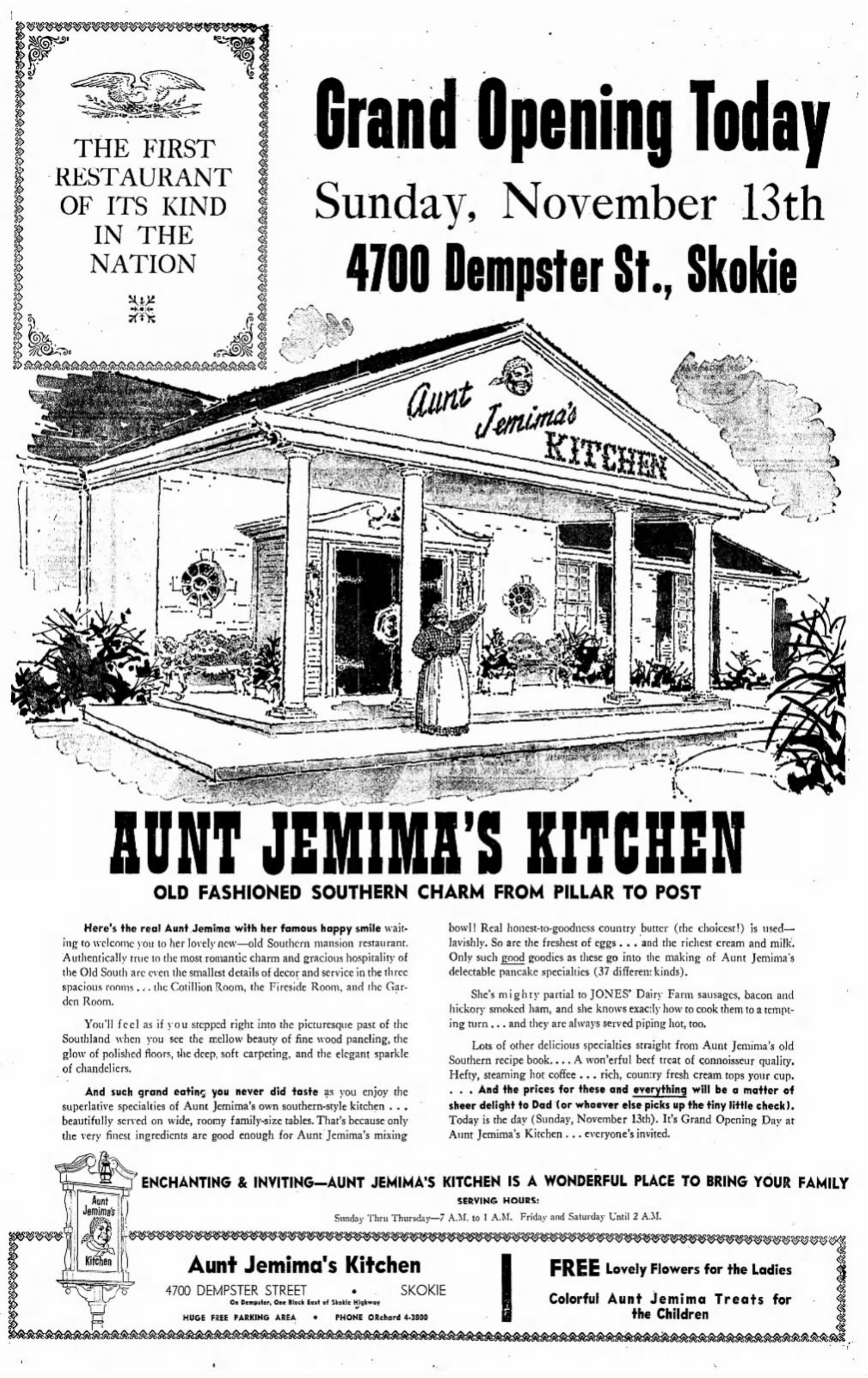
The first Aunt Jemima's Pancake House began at Disneyland in Anaheim, California, on August 17, 1955. It was located on New Orleans Street in Frontierland and featured indoor and outdoor patio seating.
AUNT JEMIMA'S KITCHEN IN SKOKIE, ILLINOIS
Aunt Jemima's Kitchen Restaurant at 4700 Dempster Street, Skokie, Illinois opened on Sunday, November 13, 1960. The two black hostesses were dressed as Aunt Jemima, with an apron and kerchief on her head would greet and seat you. They had a lot of different kinds of pancake syrups, to use with the 37 kinds of pancakes, on each table in their three dining rooms; the Cotillion Room, the Fireside Room, and the Garden Room.
Looking at the Garden Room from the Cotillion Room. You can see the variety of pancake syrups, raised above the table, in the forefront. The Fireside Room is in the distance, where you see the fireplace on the west wall.
The Cotillion room was carpeted and the decor featured large walnut tables and cane back chairs; hurricane lamps mounted on the walls and set in antique gold frames. Bright watercolor paintings hung on the wall.
The Garden room featured a New Orleans type motif with a sunken garden. it had artificial bushes and small palm leaf bushes and candy cane striped leather seats.
The Fireside room had plank oak floors and paneled walls; burled oak tables; bucket seat chairs; a natural fireplace and a display of Hudson Bay firearms.
Aunt Jemima's Kitchen, 801 Rand Road (just North of Central), in Mount Prospect. The Grand Opening was on Thursday, August 30, 1962.
Aunt Jemima's Kitchen, 4343 North Harlem Avenue, in Norridge. The Grand Opening was on Monday, September 24, 1962.
Aunt Jemima's Kitchen, Edgewater Beach Hotel, 5349 N Sheridan Road, at Berwyn Avenue, in Chicago. The Grand Opening was on Thursday, October 6, 1966. It only lasted until the hotel closed in 1967.
Aunt Jemima's Kitchen, 1016 Dixie Highway, in Chicago Heights. Opening date unknown.
Each restaurant had a seating capacity of 180 people.
When Aunt Jemima's Kitchen closed its doors in 1968 or 1969, the Gold Coin Restaurant opened. Next came the Barnum & Bagel Restaurant. Pita Inn, after 33 years at 3910 Dempster Street, razed the Barnum & Bagel Restaurantand built a new building on the property at 4710 Dempster Street, opening on Wednesday, June 3, 2015.
A BRIEF HISTORY OF THE COMPANY
In 1889, Chris Rutt and Charles Underwood of the Pearl Milling Company in St. Joseph, Missouri, developed Aunt Jemima, the first pancake-ready mix. The initial owners soon went bankrupt and sold their company to Randolph Truett (R.T.) Davis Milling Company in 1890.
R.T. Davis Milling Company hired Nancy Green to portray “Aunt Jemima” and tour the country promoting her brand. Due to the character’s popularity, R.T. Davis Milling Company fabricated a backstory through the booklet “Life of Aunt Jemima: The Most Famous Colored Woman in the World.” (The entire booklet is presented below as a footnote.)
Nancy Green as Aunt Jemima.
The image of Aunt Jemima was so popular that the company was renamed in 1914 to the Aunt Jemima Mills Company.
The Quaker Oats Company purchased the Aunt Jemima Mills Company in 1926.
The Quaker Oats Company 1926 Aunt Jemima Buckwheat, Corn & Wheat Flour wholesale package label. 12-3½lb packages.
For the Chicago Century of Progress World’s Fair in 1933-34, the advertising planners decided to bring the Aunt Jemima character back to life. They hired Anna Robinson, described as a large, gregarious woman with the face of an angel. She traveled the country promoting Aunt Jemima until her death in 1951. Quaker’s first registration of the Aunt Jemima trademark occurred in April 1937.
From 1955 until the late 1960s, Aylene Lewis was hired to portray Aunt Jemima at the Aunt Jemima Kitchen restaurant established in the newly opened Disneyland in California.
THE HISTORY OF AUNT JEMIMA
The first Aunt Jemima, Nancy Green, was born a slave in Kentucky. She was a renowned “storyteller” and was discovered by Charles Rutt and Charles Underwood in 1890 who was searching for a “Mammy” archetype to promote the first-ever box product they named the “Aunt Jemima Pancake Mix.”
In 1889 the creators of Aunt Jemima, Charles Rutt, and Charles Underwood, sold the company to Randolph Truett Davis Milling Company, who soon found Nancy Green in Chicago. The previous owners had already agreed upon her ‘look’ of a bandana and apron. R.T. Davis combined the Aunt Jemima look with a catchy tune from the Vaudeville circuit to make the Aunt Jemima brand.
Aunt Jemima's Lullaby, by S.H. Speck, 1896.
NOTE: This song was created at a time when
dialect and racial stereotypes were
regularly used as entertainment.
Green’s identity was first uncovered at the Chicago World's Columbian Exposition in 1893. She cooked the pancakes, sang songs, and told stories of the Old South. Her charismatic personality helped establish the hugely successful pancake mix. There were so many people interested in the Aunt Jemima exhibit, police were called for crowd control.Green was given an award for showmanship at the exposition. As a result of her dedication, Aunt Jemima received 50,000 orders for pancake mix. Because she excelled at promoting their product at the Exposition, Green was signed by Rutt and Underwood to an exclusive contract that gave her the sole right to portray the character of “Aunt Jemima” for the rest of her life. Green’s new career allowed her the financial freedom to support her family and also to work as an activist for negro causes and anti-poverty programs.
Nancy Green died on August 30, 1923, in Chicago, when a car collided with a laundry truck and "hurtled" onto the sidewalk where she was standing under the 46th Street elevated 'L' tracks. She is buried in a pauper's grave near a wall in the northeast quadrant of Chicago's Oak Woods Cemetery. After 97 years, a headstone was laid on Mrs. Green's grave in June of 2020.
After Green’s passing, the owner of Aunt Jemima, R.T. Davis Milling Company, experienced financial issues, and the brand was sold to Quaker Oats two years later. As for the image of Aunt Jemima, Nancy Green was followed by Anna Robinson, who’s image was changed to a painted portrait on the packaging of the mix. Next was Chicago blues singer and actress Edith Wilson. She was the first Aunt Jemima to appear in television commercials.
After Wilson, there was Ethel Ernestine Harper, a former school teacher, and actress. The fourth Aunt Jemima was Rosie Hall who was an advertising employee at Quaker Oats until she discovered their need for a new Aunt Jemima. After she died, Hall’s grave was declared a historical landmark.
Next, there was Aylene Lewis. She made her first appearance as Aunt Jemima at the opening of Aunt Jemima's Restaurant at Disneyland in 1955. In 1970 Disneyland ended its contract with the Quaker Oats Company and renamed its Aunt Jemima Restaurant to "Magnolia Tree Terrace," then changing names again in 1971 to the "River Belle Terrace."
The last woman that was known to appear as Aunt Jemima publicly was Ann Short Harrington. Harrington would make television appearances as the brand spokesperson in the New York area.
Compiled by Dr. Neil Gale, Ph.D.
In historical writing and analysis,
PRESENTISM is the introduction of present-day ideals and perspectives into depictions or interpretations of the past. I believe presentism is a form of cultural bias, and it creates a distorted understanding of the subject matter. Reading modern notions of morality into the past is committing the error of presentism. I'm well aware that historical accounts are written by people and can be slanted, so I try my hardest to present articles that are fact-based and well researched, without interjecting any of my personal opinions.
PLEASE PRACTICE HISTORICISM, WHICH IS THE INTERPRETATION OF THE PAST IN ITS OWN CONTEXT.
Because of the Aunt Jemima character's popularity, R.T. Davis Milling Company fabricated this backstory through the booklet “Life of Aunt Jemima: The Most Famous Colored Woman in the World."
Cover of "Life of Aunt Jemima: The Most Famous Colored Woman in the World," 1895.
Near the junction of the Red River with the Mississippi, in Louisiana, on the left bank of the ''Father of Waters," stands a small log cabin, differing but little from the negro cabins so plentiful in the Southern States. It is now old and dilapidated; wind whistles through crannies between the logs, birds have built their nests under the eaves, and tropical vegetation has overgrown the once trim little garden. Passengers on the river steamers always look at this cabin with more than ordinary interest. It is one of the ''sights" of that section of the country, for it was long the home and abiding place of Aunt Jemima, the celebrated colored cook, whose fame has since extended to the very bounds of civilization.
The cabin referred to is located on what is known as the Old Higbee Plantation, before the war one of the finest of its type in the South famed for its beauty and the warm hospitality of its owner. Rosebank, for so it was called, was a splendid type of an old plantation home—where the latch-string was always out to the weary traveler, and the elaborate courtesy of its owner showed to the best advantage amid the refined surroundings of his happy home.
Aunt Jemigia was born on this plantation. As a little pickaninny she chased the butterflies in the field and found new happiness in the dawn of each coming day. The fields and woods were her playgrounds—Nature was her servant, and spread most bounteous gifts before her—and the happy little pickaninny soon grew to be a bright young girl, untutored in the ways of worldly knowledge, but wise in the laws and limitations of Nature. Health was her guide. None knew its value better. To her, happiness meant perfect health, and perfect cooking an infallible prescription that cured all ills. In the very simplicity of her ideas lay their great value and thoroughness. It is not surprising, then, that Aunt Jemima at an early age was noted as a cook, unsurpassed in the preparation of certain dishes which she prepared in a manner that showed a surprising knowledge of the properties and possibilities of their wholesome ingredients. Jemima was at this time a perfect type of a handsome and vivacious negro girl, just bordering on womanhood; and her mistress, Mrs. Higbee, speedily discovered that she was a household jewel, and prized her for her kindness and nobility of character, as well as for her cooking.
Aunt Jemima was the first to discover that the three great cereals'—wheat, corn, and rice—could be so combined in pancakes that the beneficial properties and flavor of each could be retained. It was the knowledge of assimilative flavors—how to produce them by the proper combination of nutritive elements—that made her famous as a natural cook—her fame soon spread beyond the vicinity of her home—and Aunt Jemima's pancakes became a celebrity in that neighborhood. Who is there who would not admire this uneducated negro woman, who knew nothing of artificial flavoring extracts, or chemical solutions calculated to tempt the palate, yet could prepare the most tempting dishes from the most simple and healthful materials? Not satisfied with the mere ability to cook, Aunt Jemima, with a perspicacity seldom met within her race, carefully analyzed the different properties of the cereal and other foods she prepared, and it is a well-known fact that not one of her many recipes has ever been improved upon.
Aunt Jemima had no more education than others of her class. Many have claimed that she had at least a rudimentary knowledge of chemistry and botany, for her recipes have always shown familiarity with physical and chemical laws that was little short of marvelous for an uneducated person. It has been proven, nevertheless, that her skill was a natural gift.
The illustration is a correct likeness of Aunt Jemima at the Governor's Mansion, as Col. Higbee's dwelling was known during the period before the war, and it was here she cooked for many of the most famous people of this continent and Europe. The illustration shows the famous cook bringing in a plate of Aunt Jemima^s pancakes, which were somewhat like the griddle cakes so common in the South, though the ingredients in her cakes were so combined as to make them digestible; and in some manner, Aunt Jemima produced a flavor to her pancakes that no other person could imitate. When the Colonel went to the field and his family moved to New Orleans, Aunt Jemima returned to her home in the' plantation cabin whence they had taken her.
Among the notable incidents in her experience might be named the meals served by Aunt Jemima to the leaders of the Confederacy near the close of the war, when those gallant men, harassed and pursued, surrounded on all sides by the Union troops, deprived of almost the necessaries of life, found in Aunt Jemima—the ex-slave—a friend indeed. Many were the frugal meals served at her little cabin; for the gunboats had long ago destroyed the planter's mansion. The illustration on page 9 is a truthful representation of Aunt Jemima serving meals to some of the prominent leaders of the Confederacy. To be sure there was nothing very elaborate about those meals; but Aunt Jemima's cooking always liked, tasted like home cooking to the tired and weary generals, to whom her pancakes alone made up for the loss of luxuries.
Aunt Jemima's fame as a cook was accidentally revealed to the outer world several years ago. The handsome river steamer "Robert E. Lee" was en route to New Orleans.
In the main cabin sat a party of choice spirits composed of Southerners and Northerners. Among them was a man who had won fame during the civil war in the Confederate army, who won the double stars of a general before the conflict ended. The conversation drifted into a discussion of famous dinners, how they could best enjoy them, and what the courses should comprise. Finally, the old ex-general said: ''You may talk about your big dinners, but the best meal I ever ate in my life was at a negro cabin not far from where we are now. It was prepared by a slave, called Aunt Jemima. The meal consisted solely of pancakes, but I tell you, gentlemen, that no banquet ever spread tasted half as good as that 'one-course' re-past did; and, by the way, if I am not mistaken, we are nearing the point now; we stop for wood near where the cabin is located. If you gentlemen want to taste the best food combination ever made, we will step out there. She is probably still living in the old cabin she occupied during the war."
The rest of the party eagerly accepted the invitation, and when the steamer had tied up at the landing, the party, seven in number, led by the ex-general, filed down the gang-plank and started for Aunt Jemima's cabin. She was found residing in the very same place she did during the war and welcomed her visitors with all the courtesy of the antebellum darkey. It took her but a minute to prepare a batch of her famous pancakes, and without a dissenting voice the party declared the cakes the most delicious they had ever tasted; several of the gentlemen made her tempting offers for her recipe, but all were refused. In the party was a representative of the R. T. Davis Milling Company of St. Joseph, Missouri, who was on his way to New Orleans to prepare for some heavy shipments of the celebrated R.T. Davis Milling Company No. 10 Flour, which the firm was sending to that city. He made a mental note of the location of Aunt Jemima's cabin, and on returning to the steamer notified the firm of the discovery he had made.
When he reached New Orleans a reply was waiting for him, instructing him to secure the recipe, if possible. He followed the instructions to the letter, but when the firm saw the size of the draft demanded the senior member uttered a strong protest. Subsequent developments showed that the agent had not been mistaken in the value of the much-prized recipe.
It is said that nothing created so much of a stir among the negroes of Louisiana in that year, 1886, as the sale of Aunt Jemima's Pancake Flour recipe to the representative of the R. T. Davis Milling Company. One of the particular stipulations of this sale was that the money should be paid in Gold, as Aunt Jemima and her father and mother (who are represented in the picture) could not understand why United States banknotes were any better than Confederate money, which they knew, to their sorrow, was worth very little after the war was over. Another condition of the sale was that Aunt Jemima was to be taken into the employ of the firm, so as to superintend the mixing of the ingredients that make up the Pancake Flour. She is now considered the most valued employee of the firm.
No exhibit of a food product created so much of a stir at the Chicago World's Fair, held in 1893, as that of the R.T. Davis Milling Company, of St. Joseph, Missouri. It had been known to interested persons that this firm would make an effort to secure the medal and diploma for their Royal No. lo Flour, and also for their Aunt Jemima Pancake Flour, which they had been making for some time, and which is now having a wonderful sale. Their exhibit was remarkable in many ways. It consisted, first, of a huge barrel, the largest ever constructed in the world. This barrel was 12 feet across the end, 24 feet long, and 16 feet in diameter in the center.
R.T. Davis Milling Company and Aunt Jemima at the 1893 World's Fair in Chicago.
Inside were an office and parlor beautifully fitted up for the reception of visitors and the use of officers of the R.T. Davis Milling Company. Around the room were the different medals and diplomas won by this Flour in all portions of the world at various exhibitions. A few feet away from the barrel, however, and commanding the wonder and admiration of all visitors to agricultural hall, was the most remarkable and successful exhibition in the food product. This display was neither more nor less than the original Aunt Jemima, herself, making pancakes from Aunt Jemima Flour, each package of which bears her portrait. It can be imagined that it did not take the visitors to the World's Fair, especially those from the South, long to learn of this attraction. The consequence was that at times the crowd was so great around this exhibit that the assistance of special police had to be secured to keep it moving, as it often blockaded seriously that portion of the building.
The World's Fair Committee on awards did not hesitate to bestow the Augustus Saint-Gaudens Medallion and a parchment certificate for the excellence of the Aunt Jemima Pancake Flour from R.T. Davis Milling Company.
It had been surmised by the competing millers that the R.T. Davis Milling Company would carry off the first premium, but no one was prepared for the sweeping language of the award given them—a medal for every line they exhibited.
Over 50,000 orders were received at the booth alone for packages of Aunt Jemima's Pancake Flour. These orders came from Europe, Canada, and all parts of the United States.
It will be interesting for everybody to know that this matchless preparation. Aunt Jemima's Pancake Flour is a pure combination of the great food triumvirate, Wheat, Corn, and Rice. It is now kept in stock by almost every grocer in the land, and much of its phenomenal success is due to the guarantee which is given with every package, as follows:
''Buy a package of Genuine Aunt Jemima's Self-Rising Pancake Flour, and if you do not find it makes the best cakes you ever ate, return the empty box to your grocer, leave your name, and the grocer will refund the money and charge it to us."
If your grocer does not keep it, tell him the trade is supplied by all wholesale grocers.
It all began in 1946. Eddie Feigner had been pitching in the Green Pea League of Walla Walla Valley, Washington. He pitched for Kilburg's Grocery store. During one game, Feigner had easily beaten a team from Oregon 33-0. After the game was over, many of the players gathered at a tavern. The manager walked past Feigner at the tavern and made a nasty comment about Feigner's pitching ability. Feigner yelled that he could beat any team that the manager could put together with just a catcher. The manager challenged Feigner to prove it. Feigner agreed, and the only stipulation was that Feigner needed four players to bat in case the bases were loaded. The player's Feigner chose for his team were people he'd known since fourth grade. The manager's team was a prison team made of convicts. Eddie Feigner was still anxious to play.
1956
The first game for the King and His Court took place behind the barbed wire and high walls of a prison. Eddie Feigner pitched a perfect game. He struck out every batter he faced with two exceptions: One failed when he tried to bunt the ball, and the other hit a grounder to the first basemen. The four players of the King and His Court easily beat the nine-player prison team 7-0. The rest is now history.
Eddie Feigner had thrown a 12-inch softball harder than any major league pitcher has ever thrown a baseball. His underhand fastball was once timed at 114 MPH. The fastest documented pitch ever thrown by a major league pitcher is Aroldis Chapman. As of 2018, Chapman owned the record for the fastest pitch ever officially clocked at 105.1 MPH for the New York Yankees.
Ronald Wilson Reagan (1911-2004) was born in Tampico, Illinois on February 6, 1911. The family moved to Chicago, then to Galesburg, Illinois, and in 1937 moved to California.
Reagan signed a seven-year contract with Warner Bros. He spent the first few years of his Hollywood career in the "B film" unit, where, Reagan joked, the producers "didn't want them good, they wanted them Thursday." His first screen credit was the starring role in the 1937 movie Love Is on the Air, and by the end of 1939, he had already appeared in 19 films. In 1938 he starred alongside Jane Wyman in Brother Rat. They married in 1940, having a child, Maureen, and adopting a son, Michael, but the marriage ended in divorce in 1949. Warner Bros. "Kings Row" starring Ronald Reagan was nominated for the Academy Award for Best Picture in 1943.
After the outbreak of WWII (1939-1945), Reagan, an officer in the Army Reserve, was ordered to active duty in April 1942. He was assigned to the First Motion Picture Unit (officially, the 18th AAF Base Unit) in Culver City, California. In January 1943, he was sent to the Provisional Task Force Show Production Unit of "This Is The Army" at Burbank, California, then he returned to the First Motion Picture Unit. He acted and narrated military training films such as Recognition of the Japanese Zero Fighter and Beyond the Line of Duty which later won the Academy Award for Best Short film. He returned to acting after the war.
In 1952, he married fellow actress Nancy Davis.
When his film roles began to dwindle in the mid-1950s, Reagan turned to television, where he hosted and acted in a number of programs, most notably hosting the General Electric Theater for eight years on CBS.
Ronald Reagan was the host of General Electric Theater.
He acted or narrated in 71 films and worked in 17 television shows, including hosting 235 teleplays and acted in 35 episodes of General Electric Theater, and acted in 8 episodes of Death Valley Days in 1964-1965.
Reagan retired from acting in 1965, and he became active in Republican politics, being elected as the Governor of California serving from 1967 to 1975, and later as the 40th President of the United States from 1981 to 1989.
President, Ronald Reagan referenced Sesame Street in a November 14, 1985, televised speech prior to the Geneva Summit where he would meet with Mikhail Gorbachev to discuss relations between the United States and the Soviet Union. Expressing a desire for Americans and Soviets to begin better relations amidst Cold War conditions, Reagan said, "Imagine if people in our nation could see the Bolshoi Ballet again, while Soviet citizens could see American plays and hear [music] groups like the Beach Boys. And how about Soviet children watching Sesame Street?"
Kermit The Frog in a photoshopped picture with Nancy and Ronald Reagan as seen in The Muppets.
The remark prompted a response from Children's Television Workshop (CTW) Fran Kaufman, "There have been no discussions or negotiations about the series going there. But we're hoping to do a special from the Soviet Union." A co-production with Russia would not happen until eleven years later with the launch of Ulitsa Sezam. Ulitsa Sezam was the Russian co-production of Sesame Street. The series first aired on October 22, 1996, with the second rerun in 1999, the third rerun in 2003, and the fourth and last rerun in 2006.
In the Muppet episode 2478 which aired on May 4, 1988, of season 19 (1987-1988), Ronald Reagan makes a cameo appearance as a Muppet.
The Muppet "Forgetful" imagines meeting a jelly bean-loving President.
View-Master is the trademark name of a line of special-format stereoscopes and corresponding View-Master "reels," which are thin cardboard disks containing seven stereoscopic 3-D pairs of small transparent color photographs on film. It was originally manufactured and sold by Sawyer's.
The View-Master system was introduced in 1939, four years after the advent of Kodachrome color film made the use of small high-quality photographic color images practical. Tourist attraction and travel views predominated in View-Master's early lists of reels, most of which were meant to be interesting to users of all ages. Most current View-Master reels are intended for children.
Edwin Eugene Mayer worked as a pharmacist at Owl Drug store in downtown Portland, Oregon, after serving in the U.S. Army in World War I. He built up a photo-finishing business there and bought into Sawyer's Photo Finishing Service in 1919 with the help of his father August Mayer, his fiancée Eva McAnulty, and her sister Vi McAnulty.
Edwin described how he started the business in a letter dated April 1, 1954:
"Suffice to say that in 1919, what little it was, was purchased with borrowed ($3,500) money from Dad, aided by about $1,600 in insurance money Eva got when her father died and which was left in permanently, and $1,600 borrowed from Vi and repaid, along with Dad's notes, within a few years."
As the business grew, Ed Mayer incorporated in about 1926, taking on partners Harold and Beulth F. Graves, Thomas and Pauline Meyer, and Augusta and Raymond F. Kelly, renaming the business Sawyer Service, Inc. The company relocated to a large two-story building at 181 Ella St., near Morrison Street in Portland, Oregon.
The company was producing photographic postcards and album sets as souvenirs by 1926 when Harold Graves joined Sawyer's. Graves handled marketing for the products while Mayer ran the business. Later, photographic greeting cards were added to the Sawyer's product line, marketed to major department stores. Sawyer's was the nation's largest producer of scenic postcards in the 1920s and the future View-Master viewer eventually became an extension of the two-dimensional cards.
The company took the first steps towards developing the View-Master after Edwin Mayer and Graves met with William Gruber, an organ maker of German origin trained by Welte & Sons and an avid photographer living in Portland. Mayer and Gruber had both developed devices for viewing stereo images, but Gruber had made up a stereo imaging rig out of two Kodak Bantam Specials mounted together on a tripod. He designed a machine that mounted the tiny pieces of Kodachrome color transparency film into reels made from heavy paper stock. A special viewer was also designed and produced. He had the idea of updating the old-fashioned stereoscope by using the new Kodachrome 16-mm color film, which recently had become available.
A View-Master reel holds 14 film transparencies in seven pairs, making up the seven stereoscopic images. The components of each pair are viewed simultaneously, one by each eye, thus simulating binocular depth perception.
According to a 1960 court document, the Gruber-Sawyer partner venture began from that first meeting in 1938. Thereafter, Ed Mayer negotiated with Gruber while production methods and some marketing were developed. After three years, a formal agreement was entered into on February 24, 1942, between Gruber and Sawyer partners, doing business as Sawyer's.
Ed Mayer and people within the Sawyer's organization were uncertain what to call their new product, but they eventually came up with the name "View-Master". The View-Master brand name eventually came to be recognized by 65 percent of the world's population, but William Gruber disliked the name which Mayer gave it, thinking that it sounded too much like Toast-Master, Mix-Master, or some other kitchen appliance.
The View-Master was introduced at the 1939 New York World's Fair, marked "Patent Applied For". It was intended as an alternative to scenic postcards and was originally sold at photography shops, stationery stores, and scenic-attraction gift shops. The main subjects of View-Master reels were Carlsbad Caverns and the Grand Canyon.
The View-Master was marketed through Ed Mayer's photo-finishing, postcard, and greeting card company Sawyer's Service, Inc., known eventually as Sawyer's, Inc. The partnership led to the retail sales of View-Master viewers and reels. The patent on the viewing device was issued in 1940, on what came to be called the Model A viewer. Within a very short time, the View-Master took over the postcard business at Sawyer's.
1940s View-Master Reels.
Ed Mayer gave details of the company's expansion in a letter dated April 1, 1954:
In 1939, 20 years after starting the business, we had, by dint of hard work and long hours and frugal living, accumulated a business (Sawyer's) worth about $58,000.00 and Western Photo Supply Co. owning the buildings, worth about $30,000.00. The above figures were for the total business and buildings owned by the Kellys, Graves, Mayers, and Meyers. In 1946, we had already grown a lot from 1939, and Sawyer's made a lease with Western Photo Supply Co., to build and lease two new buildings to Sawyer's, in addition to the two we already had. At this point, Sawyer's also decided to change its structure from a partnership to a corporation, for various good reasons, one of which was to permit our children to participate in the stock ownership.
In the 1940s, the United States military recognized the potential for using View-Master products for personnel training, purchasing 100,000 viewers, and nearly six million reels from 1942 to the end of World War II in 1945.
After the development of the View-Master, Sawyer's, Inc. moved into a new building at 735 S.W. 20th Place in downtown Portland. The company also occupied a building next door at 740 S.W. 21st Avenue. Years later, Edwin Mayer and his Sawyer's partners purchased land in Washington County near Progress, Oregon, west of Beaverton, and built a large plant there in about 1951. The plant has since been removed and developed into a shopping center. After moving to the new plant, Mayer leased the old Sawyer's building on 20th Place to Oregon Television, Inc., KPTV, Channel 12.
In 1951, Sawyer's purchased Tru-Vue, the main competitor of View-Master. The takeover eliminated the main rival and also gained Tru-Vue's licensing rights to Walt Disney Studios. Sawyer's capitalized on the opportunity and produced numerous reels featuring Disney characters. The takeover paid off further in 1955 with reels of the newly opened Disneyland. Joe Liptak was the artist responsible for most of the Disney and the early Hanna-Barbera reels.
In 1952, Sawyers began its View-Master Personal line, which included the View-Master Personal Stereo Camera for users to make their own View-Master reels.
The View-Master Personal Stereo Camera was a 35mm film camera designed to take 3D stereo photos for viewing in a View-Master. First released in 1952, the camera took 69 pairs of photos on a 36-exposure roll 35mm film, taking one set while the film was unwound from the canister, and another set while it was rewound. Although the focus was fixed, the camera supported both variable aperture settings and shutter speeds.
It was successful at first, but the line was discontinued in ten years. This line spawned the Model D viewer, View-Master's highest-quality viewer, which was available until the early 1970s, and the Stereomatic 500, View-Master's only 3D projector. The other projectors were 2D and used only one of the images.
The Model E was introduced in 1955 with a more modern design, big ivory buttons on the picture changer levers, and a large "V" slot on top for easier reel insertion. It was released in brown and black in the United States and some other colors elsewhere. It was about 4 inches high, 5 inches wide, and 4 inches deep.
A View-Master Model E of the 1950s
The Model F was introduced in 1958. It used C-cell batteries to power an internal lighting source. Industrial designer Charles "Chuck" Harrison led the team designing the Model F View-Master. Fifty years later in 2008, Harrison won the Cooper-Hewitt Lifetime Achievement Award.
In 1962, the Bakelite[1] models were replaced with lighter plastic versions, the first of which was the Model G. This change was driven by Sawyer's new president, Bob Brost, who took over in 1959. The View-Master had been constructed originally from Kodak Tenite plastic and then Bakelite, a hard, sturdy, somewhat heavy plastic. The lightweight thermoplastic became the material of choice under Brost.
A model G View-Master viewer from the last years of the Sawyer era.
In 1966, Sawyer's was acquired by the General Aniline & Film (GAF) Corporation and became a wholly-owned subsidiary. Under GAF's ownership, View-Master reels began to feature fewer scenic and more child-friendly subjects, such as toys and cartoons. Television series was featured on View-Master reels, such as Doctor Who, Rowan & Martin's Laugh-In, Star Trek, The Man from U.N.C.L.E., Family Affair, Here's Lucy, and The Beverly Hillbillies. Actor Henry Fonda appeared in a series of TV commercials for the GAF View-Master.
From 1970 to around 1997, there were versions of "Talking View-Masters," which included audio technology with the reels with three major designs with increasing sophistication. In the early 1970s, GAF introduced the View-Master Rear Screen projector, a table-top projector that displayed images from picture wheels.
First Generation Model Talking Viewmaster, 1970.
In 1980, View-Master released the Show Beam Projector, a toy that combined the company’s stereoscopic images and flashlight technology to produce a portable hand-held projector. The Show Beam used small film cartridges that were plugged into the side of the toy. Each cartridge contained 30 full-color 2D images.
In 1981, GAF sold View-Master to a group of investors headed by Arnold Thaler, and the company was reconstituted as the View-Master International Group.
VMI acquired the Ideal Toy Company in 1984 and became known as the View-Master Ideal Group; V-M Ideal in turn was purchased by Tyco Toys in 1989.
Tyco, including the View-Master Ideal Group, merged with Mattel Inc. in 1997. V-M was placed organizationally in Mattel's pre-school division and is now marketed under the Fisher-Price imprint, who continues an emphasis on juvenile content.
In 1998, during the purchase of the Tyco Toys-owned plant by Mattel, EPA investigations began on View-Master factory supply well for the toxic chemical trichloroethylene (TCE). The plant was shut down in 2001.
In March 2009, the Fisher-Price division of toymaker Mattel announced that they had stopped production in December 2008 of the scenic reels depicting tourist attractions. These reels of picturesque scenes and landscape scenery were descendants of the first View-Master reels sold in 1939. Fisher-Price announced they would continue to produce reels of animated characters. In late 2009, Alpha-cine announced it would take up scenic reel production under an agreement with Fisher-Price.
There have been some 25 viewer models, thousands of titles, and 1.5 billion copies of reels. The basic design remained intact for reels and internal mechanisms, despite its long history and many changes in models and materials, ensuring that every reel will work in every model.
View-Master is part of the National Toy Hall of Fame of the United States.
Reels have been produced for Disneyland, many TV shows (such as The Flying Nun, Lost in Space, and The Munsters), blockbuster movies (such as The Poseidon Adventure, E.T. the Extra-Terrestrial, and Jurassic Park), and the U.S. military (for airplane and ship identification and range estimation).
David L. Bassett, an expert on anatomy and dissection, collaborated with Gruber to create a 25-volume atlas of human anatomy using the View-Master system.
View-Master produced custom reels for commercial customers to show 3-D images of products and services to potential clients. For example, in the early 1990s, Canadian restaurant chain East Side Mario's used a View-Master reel and viewers for their dessert menu.
Compiled by Neil Gale, Ph.D.
[1] Bakelite or Polyoxybenzylmethylenglycolanhydride was the first plastic made from synthetic components and was patented on December 7, 1909. The creation of a synthetic plastic was revolutionary for its electrical nonconductivity and heat-resistant properties in electrical insulators, radio and telephone casings, and such diverse products as kitchenware, jewelry, pipe stems, children's toys, and firearm parts.