February 22, 2021

Identical Triplets, Nicole, Erica, and Jaclyn Dahm Took a DNA Test and The Results Shocked Even the Experts.

The Dahm triplets were born on December 12, 1977. Nicole, Erica, and Jaclyn Dahm are special in more ways than one. Not only are they identical triplets, a genetic miracle that only happens in 1 in 65,500 births, but their striking ocean-blue eyes and golden-blonde hair is enough to make them stand out in any crowd.


It is crazy to think that all three sisters got pregnant within weeks of each other. In an interview with Playboy Jaclyn, the youngest Dahm sister, assured, “It must be that triplet bond. It’s weird how fortunate and lucky we’ve all been.” After a triple pregnancy, all three Dahm triplets gave birth to daughters in 2010! 
After Nicole, Jaclyn, and Erica had their three beautiful baby girls and got settled into motherhood, producers from The Doctors called them again in March 2017 with an interesting idea.


Over the last few years, DNA tests have become increasingly popular. The more recent advent of at-home DNA ancestry tests has completely exploded in the market. People are desperate to know about their DNA and where they really come from. That is why websites like Ancestry.com and 23andMe have become much more well known. These websites and others offer at-home DNA tests at very reasonable prices. Many companies promise to help customers find out what ethnicities they are made of.


Lisa Guerrero, a journalist from Inside Edition who was looking into the new industry of Do It Yourself DNA testing and investigating the reliability of those tests. Since the triplets were genetically identical, they would be the perfect "control group." Guerrero could use the DNA test on the triplets to determine once and for all if they were accurate.

DIY DNA test kits have become extremely common and extremely cheap. The biggest names in the industry are 23andMe and Ancestry.com, which provide affordable, easy-to-use kits, and they analyze their client's DNA samples to tell them more about their ancestry.

The Dahm sister took the test and waited for the results.


It took a few weeks for the results to arrive. The sisters were excited to learn about their ancestry, but there was one thing they were sure of—the results would be identical. The triplets shared the exact same DNA and they were essentially clones of each other.

They did not expect to be surprised by the results of the saliva tests. Nicole, Erica, and Jaclyn submitted their saliva tests to 23andme. The results would be revealed to them in a live episode of The Doctors in March 2017.
Still, Lisa Guerrero, the journalist of Inside Edition, had her doubts. But, it wasn't the triplet’s DNA she was doubtful of. Rather, she questioned the reliability of these kits.

No one was surprised by the initial results: the girls were genetically identical, three carbon copies of one person. They are so identical, that Erica can open Nicole's safe with her fingerprints—as fingerprints are unique to each individual, but identical in twins and triplets. This makes sense since all three sisters developed from the same fertilized egg and carried the same genetic code.

The first test told the triplets something they knew since birth, that they were identical.


The initial test was behind them. The doctors made sure to request a second test that would show more than if the triplets were identical. The second test was meant to provide information on where the triplet’s ancestors came from and what countries they originated from. Again, Erica, Nicole, and Jaclyn expected everything to be the same. After all, the Dahm triplets were identical. Doesn’t that mean that their DNA would be the same and therefore, their genetic heritage would also be the same?


This DNA test was much more comprehensive and detailed than the first one. Not only did it compare their own DNA sequences, but it traced back their ancestry and ethnic generation.

Naturally, since they all had the exact same DNA, they expected to have the same results. But, that's when things got tricky. The results they received showed something completely different.

So why did the results surprise everyone?

At first, everything seemed fine. They were all 99% European, genetically. But then, the results were broken down even further, and that's when the differences started emerging. Erica was, according to the test, 16% Irish and British, while Nicole was 18% Irish and 2% British more than Erica!


However, these weren't the only results that confused the triplets.

The results kept coming in, and with them, more and more differences emerged. They were French and German to varying degrees—Erica was 22.3%, Jaclyn was 18%, and Nicole was 11%. But how could it be?

How could their ancestry be different?

Every discrepancy in the tests was shocking, but the most shocking was in the percentage of Scandinavian ethnicity of the sisters. Erica and Jaclyn had the same results—they were both 7.4% Scandinavian. But, Nicole's results indicated that she was 11.4% Scandinavian, 4% more than both her sisters!

The girls were just as surprised as everybody else was. If there was one thing they were sure of, it was that their test results would be the same across the board. And why wouldn't they?


They were all born from the same fertilized egg and they carried the exact same genetic code. Even the tests themselves showed they were identical triplets!

Biology is a scientific field that's still wrapped in mystery and there are many things we don't know yet. But, most experts would agree that identical twins or triplets share the same genes and the same ancestry. 

Dr. Travis Stork, the host of The Doctors TV Show, was the first to suggest a solution to the mystery. His conclusion was that these at-home tests shouldn't be taken too seriously, and should be regarded as light entertainment rather than a serious, scientific experiment.


The results of the tests were revealed on a live episode of The Doctors, and as experienced as the sisters were in front of a camera, they couldn't hide their shock. Nicole was the first to speak, and she said, “I’m surprised because we came from the same egg and we have the same DNA.”

Dr. Stork also voiced his opinion, telling the sisters and the audience that these kinds of tests shouldn't be regarded as a real genetic test, but more as "entertainment."


Dr. Stork explained further that as advanced as the science of biology is, these at-home test kits aren't quite advanced enough to produce 100% accurate results. They can give some approximation of one's heritage, but the more specific they get, the more that flaws and inaccuracies emerge. As he said, “You can’t just spit in a cup and have every single answer that you are looking for."

Compiled by Dr. Neil Gale, Ph.D.


Pictures from Playboy Magazine [Rated R]
▼▼▼▼▼▼▼▼▼▼▼▼▼▼▼▼▼▼▼[Rated R]▼▼▼▼▼▼▼▼▼▼▼▼▼▼▼▼▼▼


▼▼▼▼▼▼▼▼▼▼▼▼▼▼▼▼▼▼▼[Rated R]▼▼▼▼▼▼▼▼▼▼▼▼▼▼▼▼▼▼


▼▼▼▼▼▼▼▼▼▼▼▼▼▼▼▼▼▼▼[Rated R]▼▼▼▼▼▼▼▼▼▼▼▼▼▼▼▼▼▼


▼▼▼▼▼▼▼▼▼▼▼▼▼▼▼▼▼▼▼[Rated R]▼▼▼▼▼▼▼▼▼▼▼▼▼▼▼▼▼▼


▼▼▼▼▼▼▼▼▼▼▼▼▼▼▼▼▼▼▼[Rated R]▼▼▼▼▼▼▼▼▼▼▼▼▼▼▼▼▼▼


▼▼▼▼▼▼▼▼▼▼▼▼▼▼▼▼▼▼▼[Rated R]▼▼▼▼▼▼▼▼▼▼▼▼▼▼▼▼▼▼


January 23, 2021

1965 Sixfinger, by Topper Toys.

Deluxe Reading was a toy manufacturer based in Elizabeth, New Jersey USA which produced toys under several brand names including Deluxe Topper, Deluxe Toy Creations, Deluxe Reading, Topper Corp., Topper Toy Group, and Topper Toys. The Topper Toys brand was most used in print advertisements and television commercials (children's TV). It was founded and run by Henry Orenstein, a holocaust survivor.


In a long list of “you’ll poke your eye out” toys, Sixfinger has to top the list. What kid wouldn’t want a sixth finger? Especially when that sixth finger shoots cap bombs, “secret bullets,” message missiles, and fragmentation bombs. It also acts as a ballpoint pen, which helps with filling out those emergency room admission forms. Plus, it looks a little... disturbing.

NOTABLE TOYS
  1. Baby Magic (Topper Toys)
  2. Battlewagon (Deluxe Reading)
  3. Candy Fashion (Deluxe Reading)
  4. Charlie and Me (Topper Toys)
  5. The Chief (Deluxe Reading)
  6. Clock-A-Word Action Game (Topper Toys)
  7. Crusader 101 (Deluxe Reading)
  8. Dawn Doll (Topper Toys 1970)
  9. Defender Dan (Deluxe Reading)
  10. Ding-A-Ling Robots (Topper Toys 1970)
  11. Dream Kitchen (Reading Deluxe circa 1961)
  12. Fat Sam (Topper Toys)
  13. Fingers Harry (Topper Toys)
  14. Funny Face (Topper Toys)
  15. Go COMA Swingers Dolls (Topper Toys)
  16. Jimmy Jet (Deluxe Reading)
  17. Johnny Astro (Topper Toys)
  18. Johnny Eagle Guns (Topper Toys)
  19. Johnny Express Trucks (Topper Toys)
  20. Johnny Lightning (Topper Toys 1969)
  21. Johnny Seven O.M.A. (Topper Toys 1964)
  22. Johnny Spacemobile X-7 (Topper Toys)
  23. Johnny Speed (Topper Toys)
  24. Johnny Service (Topper Toys 1966)
  25. Johnny Toymaker (Topper Toys)
  26. Jimmy Jet (Deluxe Reading 1961)
  27. Lil Miss Fussy (Topper Toys)
  28. Lillie Doll
  29. Motorized Monster Maker Kit (Topper Toys)
  30. Mr Pierre (Topper Toys)
  31. Multi-Pistol 09 (Topper Toys 1965)
  32. Operation X-500 (Deluxe Reading 1960)
  33. Penny Brite Doll (Topper Toys/Deluxe Reading 1963)
  34. Playmobile Dashboard (Deluxe Reading 1961)
  35. Secret Sam Spy Case (Topper Toys)
  36. Sesame Street dolls (Topper Toys 1970-1973)
  37. Silly Safari (Topper Toys)
  38. Sixfinger (Topper Toys 1965)
  39. Super Helmet Seven (Topper Toys 1966)
  40. Suzy Cute Doll (Topper Toys 1964)
  41. Suzy Homemaker doll and accessories (Topper Toys)
  42. Suzy Homemaker Super Safety Oven (Topper Toys)[2]
  43. Tiger Joe Tank (Deluxe Reading)
  44. The Tigers (Topper Toys 1966)
TV COMMERCIALS


Compiled by Dr. Neil Gale, Ph.D.

January 2, 2021

The Story about Aunt Jemima and the Aunt Jemima's Kitchen Restaurants.

The first Aunt Jemima's Pancake House began at Disneyland in Anaheim, California, on August 17, 1955. It was located on New Orleans Street in Frontierland and featured indoor and outdoor patio seating.

AUNT JEMIMA'S KITCHEN IN SKOKIE, ILLINOIS 


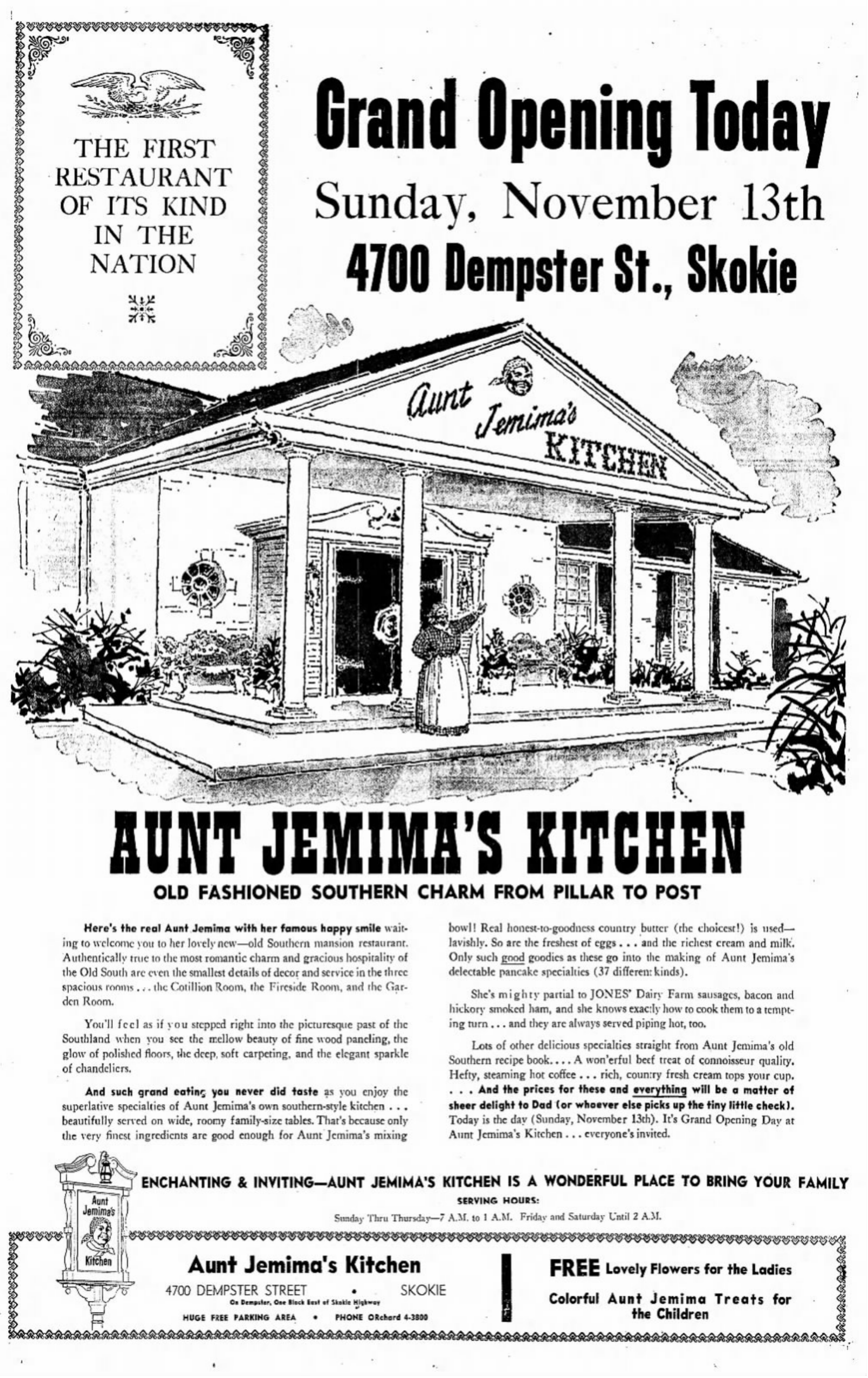
Aunt Jemima's Kitchen Restaurant at 4700 Dempster Street, Skokie, Illinois opened on Sunday, November 13, 1960. The two black hostesses were dressed as Aunt Jemima, with an apron and kerchief on her head would greet and seat you. They had a lot of different kinds of pancake syrups, to use with the 37 kinds of pancakes, on each table in their three dining rooms; the Cotillion Room, the Fireside Room, and the Garden Room.
Looking at the Garden Room from the Cotillion Room. You can see the variety of pancake syrups, raised above the table, in the forefront. The Fireside Room is in the distance, where you see the fireplace on the west wall.
The Cotillion room was carpeted and the decor featured large walnut tables and cane back chairs; hurricane lamps mounted on the walls and set in antique gold frames. Bright watercolor paintings hung on the wall.

The Garden room featured a New Orleans type motif with a sunken garden. it had artificial bushes and small palm leaf bushes and candy cane striped leather seats.

The Fireside room had plank oak floors and paneled walls; burled oak tables; bucket seat chairs; a natural fireplace and a display of Hudson Bay firearms.

Aunt Jemima's Kitchen, 801 Rand Road (just North of Central), in Mount Prospect. The Grand Opening was on Thursday, August 30, 1962.

Aunt Jemima's Kitchen, 4343 North Harlem Avenue, in Norridge. The Grand Opening was on Monday, September 24, 1962.

Aunt Jemima's Kitchen, Edgewater Beach Hotel, 5349 N Sheridan Road, at Berwyn Avenue, in Chicago. The Grand Opening was on Thursday, October 6, 1966. It only lasted until the hotel closed in 1967.

Aunt Jemima's Kitchen, 1016 Dixie Highway, in Chicago Heights. Opening date unknown.

Each restaurant had a seating capacity of 180 people.
CLICK TO VIEW A READABLE SIZE AD


Aunt Jemima's Kitchen Paper Plate.
When Aunt Jemima's Kitchen closed its doors in 1968 or 1969, the Gold Coin Restaurant opened. Next came the Barnum & Bagel Restaurant. Pita Inn, after 33 years at 3910 Dempster Street, razed the Barnum & Bagel Restaurant and built a new building on the property at 4710 Dempster Street, opening on Wednesday, June 3, 2015.

A BRIEF HISTORY OF THE COMPANY
In 1889, Chris Rutt and Charles Underwood of the Pearl Milling Company in St. Joseph, Missouri, developed Aunt Jemima, the first pancake-ready mix. The initial owners soon went bankrupt and sold their company to Randolph Truett (R.T.) Davis Milling Company in 1890. 

R.T. Davis Milling Company hired Nancy Green to portray “Aunt Jemima” and tour the country promoting her brand. Due to the character’s popularity, R.T. Davis Milling Company fabricated a backstory through the booklet “Life of Aunt Jemima: The Most Famous Colored Woman in the World.” (The entire booklet is presented below as a footnote.)
Nancy Green as Aunt Jemima.


The image of Aunt Jemima was so popular that the company was renamed in 1914 to the Aunt Jemima Mills Company. 

The Quaker Oats Company purchased the Aunt Jemima Mills Company in 1926.
The Quaker Oats Company 1926 Aunt Jemima Buckwheat, Corn & Wheat Flour wholesale package label. 12-3½lb packages.


For the Chicago Century of Progress World’s Fair in 1933-34, the advertising planners decided to bring the Aunt Jemima character back to life. They hired Anna Robinson, described as a large, gregarious woman with the face of an angel. She traveled the country promoting Aunt Jemima until her death in 1951. Quaker’s first registration of the Aunt Jemima trademark occurred in April 1937. 

From 1955 until the late 1960s, Aylene Lewis was hired to portray Aunt Jemima at the Aunt Jemima Kitchen restaurant established in the newly opened Disneyland in California. 
THE HISTORY OF AUNT JEMIMA
The first Aunt Jemima, Nancy Green, was born a slave in Kentucky. She was a renowned “storyteller” and was discovered by Charles Rutt and Charles Underwood in 1890 who was searching for a “Mammy” archetype to promote the first-ever box product they named the “Aunt Jemima Pancake Mix.” 

In 1889 the creators of Aunt Jemima, Charles Rutt, and Charles Underwood, sold the company to Randolph Truett Davis Milling Company, who soon found Nancy Green in Chicago. The previous owners had already agreed upon her ‘look’ of a bandana and apron. R.T. Davis combined the Aunt Jemima look with a catchy tune from the Vaudeville circuit to make the Aunt Jemima brand.
Aunt Jemima's Lullaby, by S.H. Speck, 1896.
NOTE: This song was created at a time when
dialect and racial stereotypes were
regularly used as entertainment.

Green’s identity was first uncovered at the Chicago World's Columbian Exposition in 1893. She cooked the pancakes, sang songs, and told stories of the Old South. Her charismatic personality helped establish the hugely successful pancake mix. There were so many people interested in the Aunt Jemima exhibit, police were called for crowd control. Green was given an award for showmanship at the exposition. As a result of her dedication, Aunt Jemima received 50,000 orders for pancake mix. Because she excelled at promoting their product at the Exposition, Green was signed by Rutt and Underwood to an exclusive contract that gave her the sole right to portray the character of “Aunt Jemima” for the rest of her life. Green’s new career allowed her the financial freedom to support her family and also to work as an activist for negro causes and anti-poverty programs.
Nancy Green died on August 30, 1923, in Chicago, when a car collided with a laundry truck and "hurtled" onto the sidewalk where she was standing under the 46th Street elevated 'L' tracks. She is buried in a pauper's grave near a wall in the northeast quadrant of Chicago's Oak Woods Cemetery. After 97 years, a headstone was laid on Mrs. Green's grave in June of 2020.
After Green’s passing, the owner of Aunt Jemima, R.T. Davis Milling Company, experienced financial issues, and the brand was sold to Quaker Oats two years later. As for the image of Aunt Jemima, Nancy Green was followed by Anna Robinson, who’s image was changed to a painted portrait on the packaging of the mix. Next was Chicago blues singer and actress Edith Wilson. She was the first Aunt Jemima to appear in television commercials. 

After Wilson, there was Ethel Ernestine Harper, a former school teacher, and actress. The fourth Aunt Jemima was Rosie Hall who was an advertising employee at Quaker Oats until she discovered their need for a new Aunt Jemima. After she died, Hall’s grave was declared a historical landmark. 

Next, there was Aylene Lewis. She made her first appearance as Aunt Jemima at the opening of Aunt Jemima's Restaurant at Disneyland in 1955. In 1970 Disneyland ended its contract with the Quaker Oats Company and renamed its Aunt Jemima Restaurant to "Magnolia Tree Terrace," then changing names again in 1971 to the "River Belle Terrace."
The last woman that was known to appear as Aunt Jemima publicly was Ann Short Harrington. Harrington would make television appearances as the brand spokesperson in the New York area.

Compiled by Dr. Neil Gale, Ph.D.


In historical writing and analysis, PRESENTISM is the introduction of present-day ideals and perspectives into depictions or interpretations of the past. I believe presentism is a form of cultural bias, and it creates a distorted understanding of the subject matter. Reading modern notions of morality into the past is committing the error of presentism. I'm well aware that historical accounts are written by people and can be slanted, so I try my hardest to present articles that are fact-based and well researched, without interjecting any of my personal opinions.
PLEASE PRACTICE HISTORICISM, WHICH IS THE INTERPRETATION OF THE PAST IN ITS OWN CONTEXT.


Because of the Aunt Jemima character's popularity, R.T. Davis Milling Company fabricated this backstory through the booklet “Life of Aunt Jemima: The Most Famous Colored Woman in the World."
Cover of "Life of Aunt Jemima: The Most Famous Colored Woman in the World," 1895.


Near the junction of the Red River with the Mississippi, in Louisiana, on the left bank of the ''Father of Waters," stands a small log cabin, differing but little from the negro cabins so plentiful in the Southern States. It is now old and dilapidated; wind whistles through crannies between the logs, birds have built their nests under the eaves, and tropical vegetation has overgrown the once trim little garden. Passengers on the river steamers always look at this cabin with more than ordinary interest. It is one of the ''sights" of that section of the country, for it was long the home and abiding place of Aunt Jemima, the celebrated colored cook, whose fame has since extended to the very bounds of civilization.

The cabin referred to is located on what is known as the Old Higbee Plantation, before the war one of the finest of its type in the South famed for its beauty and the warm hospitality of its owner. Rosebank, for so it was called, was a splendid type of an old plantation home—where the latch-string was always out to the weary traveler, and the elaborate courtesy of its owner showed to the best advantage amid the refined surroundings of his happy home.

Aunt Jemigia was born on this plantation. As a little pickaninny she chased the butterflies in the field and found new happiness in the dawn of each coming day. The fields and woods were her playgrounds—Nature was her servant, and spread most bounteous gifts before her—and the happy little pickaninny soon grew to be a bright young girl, untutored in the ways of worldly knowledge, but wise in the laws and limitations of Nature. Health was her guide. None knew its value better. To her, happiness meant perfect health, and perfect cooking an infallible prescription that cured all ills. In the very simplicity of her ideas lay their great value and thoroughness. It is not surprising, then, that Aunt Jemima at an early age was noted as a cook, unsurpassed in the preparation of certain dishes which she prepared in a manner that showed a surprising knowledge of the properties and possibilities of their wholesome ingredients. Jemima was at this time a perfect type of a handsome and vivacious negro girl, just bordering on womanhood; and her mistress, Mrs. Higbee, speedily discovered that she was a household jewel, and prized her for her kindness and nobility of character, as well as for her cooking.

Aunt Jemima was the first to discover that the three great cereals'—wheat, corn, and rice—could be so combined in pancakes that the beneficial properties and flavor of each could be retained. It was the knowledge of assimilative flavors—how to produce them by the proper combination of nutritive elements—that made her famous as a natural cook—her fame soon spread beyond the vicinity of her home—and Aunt Jemima's pancakes became a celebrity in that neighborhood. Who is there who would not admire this uneducated negro woman, who knew nothing of artificial flavoring extracts, or chemical solutions calculated to tempt the palate, yet could prepare the most tempting dishes from the most simple and healthful materials? Not satisfied with the mere ability to cook, Aunt Jemima, with a perspicacity seldom met within her race, carefully analyzed the different properties of the cereal and other foods she prepared, and it is a well-known fact that not one of her many recipes has ever been improved upon.

Aunt Jemima had no more education than others of her class. Many have claimed that she had at least a rudimentary knowledge of chemistry and botany, for her recipes have always shown familiarity with physical and chemical laws that was little short of marvelous for an uneducated person. It has been proven, nevertheless, that her skill was a natural gift.

The illustration is a correct likeness of Aunt Jemima at the Governor's Mansion, as Col. Higbee's dwelling was known during the period before the war, and it was here she cooked for many of the most famous people of this continent and Europe. The illustration shows the famous cook bringing in a plate of Aunt Jemima^s pancakes, which were somewhat like the griddle cakes so common in the South, though the ingredients in her cakes were so combined as to make them digestible; and in some manner, Aunt Jemima produced a flavor to her pancakes that no other person could imitate. When the Colonel went to the field and his family moved to New Orleans, Aunt Jemima returned to her home in the' plantation cabin whence they had taken her.

Among the notable incidents in her experience might be named the meals served by Aunt Jemima to the leaders of the Confederacy near the close of the war, when those gallant men, harassed and pursued, surrounded on all sides by the Union troops, deprived of almost the necessaries of life, found in Aunt Jemima—the ex-slave—a friend indeed. Many were the frugal meals served at her little cabin; for the gunboats had long ago destroyed the planter's mansion. The illustration on page 9 is a truthful representation of Aunt Jemima serving meals to some of the prominent leaders of the Confederacy. To be sure there was nothing very elaborate about those meals; but Aunt Jemima's cooking always liked, tasted like home cooking to the tired and weary generals, to whom her pancakes alone made up for the loss of luxuries.

Aunt Jemima's fame as a cook was accidentally revealed to the outer world several years ago. The handsome river steamer "Robert E. Lee" was en route to New Orleans.

In the main cabin sat a party of choice spirits composed of Southerners and Northerners. Among them was a man who had won fame during the civil war in the Confederate army, who won the double stars of a general before the conflict ended. The conversation drifted into a discussion of famous dinners, how they could best enjoy them, and what the courses should comprise. Finally, the old ex-general said: ''You may talk about your big dinners, but the best meal I ever ate in my life was at a negro cabin not far from where we are now. It was prepared by a slave, called Aunt Jemima. The meal consisted solely of pancakes, but I tell you, gentlemen, that no banquet ever spread tasted half as good as that 'one-course' re-past did; and, by the way, if I am not mistaken, we are nearing the point now; we stop for wood near where the cabin is located. If you gentlemen want to taste the best food combination ever made, we will step out there. She is probably still living in the old cabin she occupied during the war."

The rest of the party eagerly accepted the invitation, and when the steamer had tied up at the landing, the party, seven in number, led by the ex-general, filed down the gang-plank and started for Aunt Jemima's cabin. She was found residing in the very same place she did during the war and welcomed her visitors with all the courtesy of the antebellum darkey. It took her but a minute to prepare a batch of her famous pancakes, and without a dissenting voice the party declared the cakes the most delicious they had ever tasted; several of the gentlemen made her tempting offers for her recipe, but all were refused. In the party was a representative of the R. T. Davis Milling Company of St. Joseph, Missouri, who was on his way to New Orleans to prepare for some heavy shipments of the celebrated R.T. Davis Milling Company No. 10 Flour, which the firm was sending to that city. He made a mental note of the location of Aunt Jemima's cabin, and on returning to the steamer notified the firm of the discovery he had made.

When he reached New Orleans a reply was waiting for him, instructing him to secure the recipe, if possible. He followed the instructions to the letter, but when the firm saw the size of the draft demanded the senior member uttered a strong protest. Subsequent developments showed that the agent had not been mistaken in the value of the much-prized recipe.

It is said that nothing created so much of a stir among the negroes of Louisiana in that year, 1886, as the sale of Aunt Jemima's Pancake Flour recipe to the representative of the R. T. Davis Milling Company. One of the particular stipulations of this sale was that the money should be paid in Gold, as Aunt Jemima and her father and mother (who are represented in the picture) could not understand why United States banknotes were any better than Confederate money, which they knew, to their sorrow, was worth very little after the war was over. Another condition of the sale was that Aunt Jemima was to be taken into the employ of the firm, so as to superintend the mixing of the ingredients that make up the Pancake Flour. She is now considered the most valued employee of the firm.

No exhibit of a food product created so much of a stir at the Chicago World's Fair, held in 1893, as that of the R.T. Davis Milling Company, of St. Joseph, Missouri. It had been known to interested persons that this firm would make an effort to secure the medal and diploma for their Royal No. lo Flour, and also for their Aunt Jemima Pancake Flour, which they had been making for some time, and which is now having a wonderful sale. Their exhibit was remarkable in many ways. It consisted, first, of a huge barrel, the largest ever constructed in the world. This barrel was 12 feet across the end, 24 feet long, and 16 feet in diameter in the center.
R.T. Davis Milling Company and Aunt Jemima at the 1893 World's Fair in Chicago.


Inside were an office and parlor beautifully fitted up for the reception of visitors and the use of officers of the R.T. Davis Milling Company. Around the room were the different medals and diplomas won by this Flour in all portions of the world at various exhibitions. A few feet away from the barrel, however, and commanding the wonder and admiration of all visitors to agricultural hall, was the most remarkable and successful exhibition in the food product. This display was neither more nor less than the original Aunt Jemima, herself, making pancakes from Aunt Jemima Flour, each package of which bears her portrait. It can be imagined that it did not take the visitors to the World's Fair, especially those from the South, long to learn of this attraction. The consequence was that at times the crowd was so great around this exhibit that the assistance of special police had to be secured to keep it moving, as it often blockaded seriously that portion of the building. 

The World's Fair Committee on awards did not hesitate to bestow the Augustus Saint-Gaudens Medallion and a parchment certificate for the excellence of the Aunt Jemima Pancake Flour from R.T. Davis Milling Company. 

It had been surmised by the competing millers that the R.T. Davis Milling Company would carry off the first premium, but no one was prepared for the sweeping language of the award given them—a medal for every line they exhibited.

Over 50,000 orders were received at the booth alone for packages of Aunt Jemima's Pancake Flour. These orders came from Europe, Canada, and all parts of the United States.

It will be interesting for everybody to know that this matchless preparation. Aunt Jemima's Pancake Flour is a pure combination of the great food triumvirate, Wheat, Corn, and Rice. It is now kept in stock by almost every grocer in the land, and much of its phenomenal success is due to the guarantee which is given with every package, as follows: 
''Buy a package of Genuine Aunt Jemima's Self-Rising Pancake Flour, and if you do not find it makes the best cakes you ever ate, return the empty box to your grocer, leave your name, and the grocer will refund the money and charge it to us."
If your grocer does not keep it, tell him the trade is supplied by all wholesale grocers.

MANUFACTURED BY R.T. DAVIS MILLING COMPANY,
ST. JOSEPH, MISSOURI 
U. S. A.

December 19, 2020

Glass Blocks; a Chicago Invention for the 1893 World's Columbian Exposition.

Glass block, or glass brick, has an interesting history and connection to Chicago via two Chicago World’s Fairs and multiple Chicago based companies.

Gustave Falconnier
Glass Designer
The 1893 World's Columbian Exposition is known for introducing many things to the United States. One lesser-known first at the World's Fair showed the United States the first glass bricks made by Gustave Falconnier. 

Falconnier, an architect, Chicago city council member, prefect of Nyon, France, and a graduate of the Ecole des Beaux-Arts in Paris held many patents in the 1880s for various types of glass blocks of interesting geometric shapes.

At the Columbian Exposition, Falconnier exhibited his glass in buildings outside of the Horticultural Building, showing their potential uses in architecture and horticulture. Falconnier was given an award by the fair commission for, “a new departure in glass building.”

Despite being shown in the horticultural pavilion, the fair commission gave him a somewhat backhanded compliment, saying that, “Their adaptability for conservatories intended for plant cultivation has not yet been fully demonstrated, but for conservatory vestibules and other rural effects they are well adapted.” And finally, “In the construction of surgical, photographic, and other experimental laboratories, where extra subdued light is required, they possess great merit.”
The Northern Pavillion of the Horticultural Building and Exhibit of Hot-Houses and Summer-Houses.
Falconnier’s glass block had a flaw that prevented it from taking hold in America. Because they were blown glass, the blocks needed a hole. Even a small hole, eventually plugged up leading to fogging. Once fogged, the bricks would need to be replaced. A tall order indeed for something that is meant to be permanently put into a wall.

Glass block would get a second chance at Chicago's Century of Progress International Exposition in 1933 before it really took hold in US architecture. However, other types of architectural glass that would be formative to glass block’s future were taking shape in Chicago.

The popularization of Art Deco glass block walls came via the crowd-pleasing thirteen houses of the future displayed at the 1933–34 Chicago World’s Fair. Glass block walls gave builders an avant-garde 20th-Century sensibility that people really liked.

The Chicago World’s Fair buildings, at the time, considered the height of American modernity, influenced United States architectural design for many years thereafter. The Century of Progress which had been planned before the crash of 1929, opened in the middle of a worldwide economic crisis. Despite that fact, or perhaps because of it, the Century of Progress resolutely focused on an optimistic vision of the United States yet to come, a premise that proved to be a wise move as it attracted so many visitors that organizers kept the fair open for a second year.
Owens-Illinois exhibit at the Chicago Century of Progress International Exposition, 1933-34.
One of the Fair's most popular exhibits featured thirteen futuristic houses clustered together on the shores of Lake Michigan. Those houses, built from innovative construction materials and with several examples clearly paying homage to the European “International Style” or the colloquial “Streamline Moderne,” turned out to be a crowd-pleaser. 

Few fairgoers actually contemplated living in homes like George Fred Keck’s Glass House, a three-story, glass-clad, polygonal tower suspended from a central pole that clearly owed a lot to Le Corbusier’s idea of the house as a “machine for living,” but most attendees marveled at the technology displayed within and without. 
Keck’s design, which the fair billed as the “House of Tomorrow,” made the June 1933 cover of Popular Mechanics.
Keck’s house controlled its own climate via central systems and sealed windows. It included not only a garage for the car but a hanger for the family plane. Keck’s design, which the fair billed as the “House of Tomorrow,” made the June 1933 cover of Popular Mechanics. The idea of an “automatic” house that heated and cooled itself, rotated to face the sun, and opened its own Venetian blinds caught the fancy of fairgoers. It likewise influenced architects throughout the United States in the subsequent years before World War II. Bits and pieces of the fair’s dramatic architecture showed up on the cultural periphery. 

Compiled by Dr. Neil Gale, Ph.D.